|
Service page |
What pet owners may search |
What they need before booking |
|---|---|---|
|
Wellness exams |
“annual vet checkup cost,” “dog wellness exam” |
What is checked, how long the visit takes, pricing guidance and available wellness plans |
|
Vaccinations |
“puppy shots schedule,” “cat vaccines near me” |
Core and lifestyle vaccines, timing by age and cost per visit |
|
Dental care |
“dog teeth cleaning cost,” “cat dental anesthesia” |
Why anesthesia may be used, what is included, estimate ranges and recovery information |
|
Surgery |
“dog lump removal vet,” “soft tissue surgery” |
Relevant credentials, monitoring, pain management and how estimates are prepared |
|
Spay and neuter |
“spay cost near me,” “when to neuter a puppy” |
Timing considerations, pre-operative steps, drop-off and pickup, and aftercare |
|
Diagnostics |
“dog X-ray same day,” “pet ultrasound” |
Equipment available, typical turnaround time and how results are shared |
|
Urgent and emergency care |
“emergency vet open now” |
Hours, walk-in or triage policy, services available and after-hours referral information |
|
Puppy and kitten care |
“first vet visit puppy” |
First-visit checklist, package information and what to bring |
|
Senior pet care |
“senior dog bloodwork” |
Screening recommendations, mobility and pain-management options, and ongoing care plans |
|
End-of-life care |
“pet euthanasia at home” |
Available options, what to expect, aftercare, cremation and pricing guidance |
The Veterinary Service Pages Pet Owners Need Before They Book
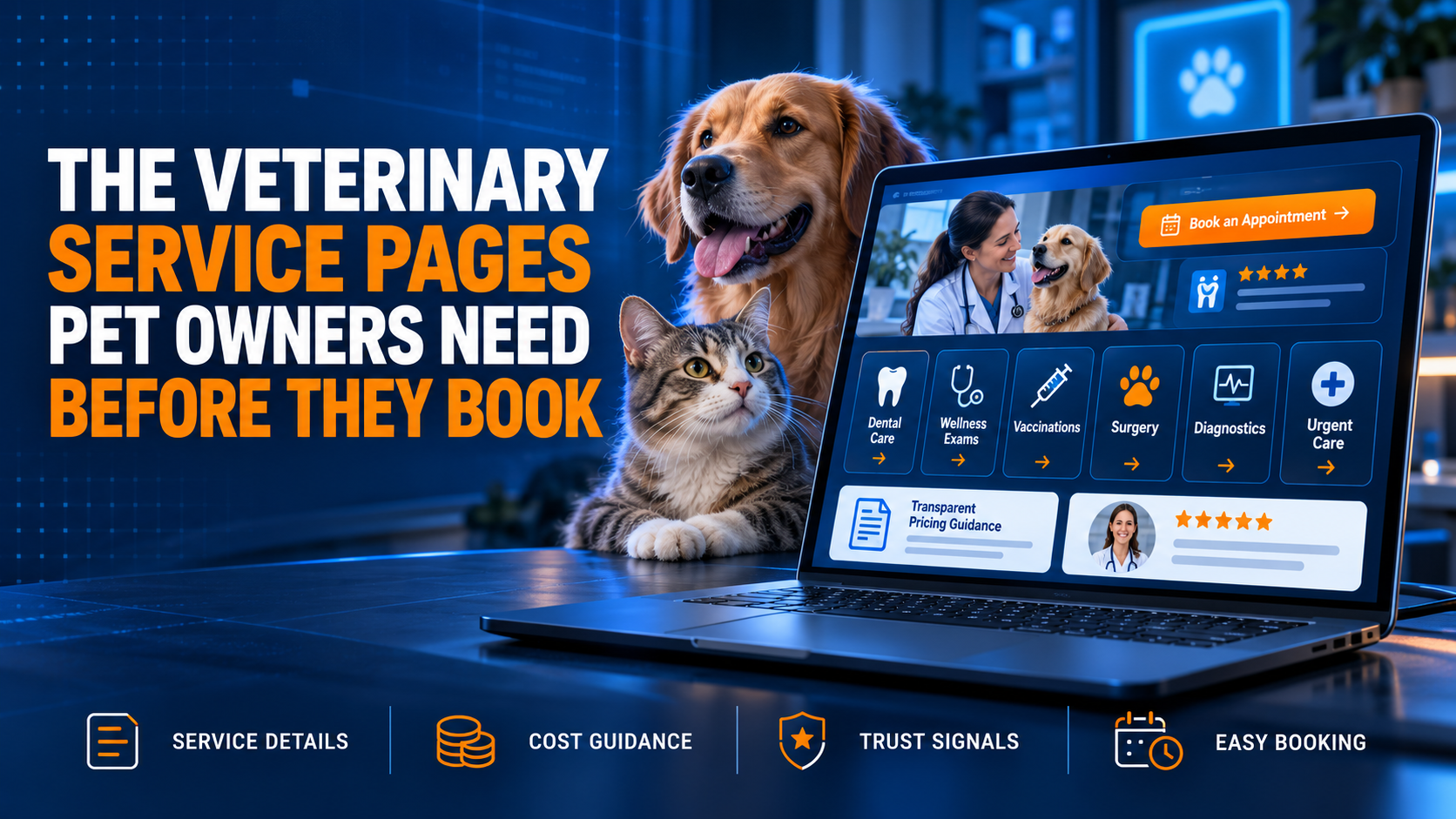
Pet owners often begin deciding which clinic to contact before they speak with anyone.
They may search for “dog teeth cleaning near me” at 10 p.m. and compare several clinic websites. One page explains the procedure, provides useful pricing guidance and makes the next step clear. Another offers a short list of services and a phone number.
Clinical quality matters, but prospective clients cannot assess it from a thin list of services. They need enough information to understand the care, trust the clinic and know how to book.
Quick answer: Most general veterinary practices benefit from a dedicated page for each priority service they want pet owners to find and book. The right set depends on the services offered, business priorities, local demand and available evidence from sources such as Google Search Console and booking data. Each page should explain what the service involves, address common cost questions, introduce the people providing the care, include relevant proof and make the next step clear.
Why one Services page may not be enough
Many pet owners search by symptom, procedure or immediate need rather than using only a broad phrase such as “veterinary services.” Their searches may include:
“cat vomiting vet”
“puppy vaccines cost”
“dog X-ray same day”
“emergency vet open now”
A single page containing a list of services is unlikely to answer the different questions behind all those searches.
The wider evidence also shows why useful service information matters:
Cost is a major barrier. In the 2025 PetSmart Charities-Gallup study, 52% of surveyed U.S. dog and cat owners said they had skipped or declined veterinary care in the previous year. Among those who skipped or declined care, 71% cited cost as a reason. In separate Canadian research, 50% of surveyed pet parents said they had skipped or declined needed care.
Booking friction can affect the decision. PetDesk’s 2025 Pet Parent Research Report found that 57% of surveyed North American pet parents had experienced difficulty booking an appointment, while 78% considered the ability to book at any time on any device important.
The website influences clinic selection. In Vetstoria’s commissioned 2026 research, 83% of surveyed pet owners considered a practice’s website important when choosing a clinic, and 34% cited the inability to book online as a problem.
AI is becoming another discovery channel. BrightLocal’s 2026 survey of U.S. adults found that 45% had used ChatGPT or another generative AI tool for local business recommendations, up from 6% one year earlier. This was research about local businesses generally, not veterinary clinics specifically, but it shows how discovery habits are changing.
A thin Services page is unlikely to meet all four needs. Well-built service pages can give pet owners clearer answers while helping search systems understand what the clinic offers.
10 veterinary service pages to consider
Start with the services that matter most to the clinic and its clients. Revenue, appointment demand, Search Console data, local search results and front-desk questions can all help determine what should come first.
Only create a separate page when the clinic offers the service and has enough useful, distinct information to support it.
Two supporting pages may also be valuable:
New clients: Records transfer, forms, first-visit steps and what to bring.
Pricing and payment: Useful ranges, deposits, payment plans, accepted financing and pet-insurance information.
Exotics, behavior, rehabilitation and other specialties may warrant their own pages when the clinic offers them and there is a distinct client need. These services can represent more specific search opportunities, but the demand and competition should be assessed in the clinic’s market before prioritizing them.
What a useful veterinary service page should include
The goal is not to reach an arbitrary word count or repeat a keyword. It is to answer the questions that may stop a pet owner from taking the next step.
A strong service page will usually include the following elements.
1. A clear page title and main heading
“Dog and Cat Dental Cleaning in [City]” tells the visitor more than “Dentistry.” Make the service clear in the title and main heading, and include the location naturally where it helps the reader. It does not need to be forced into every heading or URL.
2. Who the service is for
Explain the signs or situations that may lead someone to seek the service. A dental page, for example, might discuss bad breath, red gums, difficulty chewing or dropping food.
Avoid diagnosing the animal on the page. Help the owner recognize when it may be time to contact the clinic.
3. What happens during the visit
Describe the process in plain language. Depending on the service, that may include check-in, examination, testing, anesthesia, treatment, pickup and follow-up.
Knowing what to expect can reduce uncertainty for both the owner and the pet.
4. Useful cost guidance
Where possible, provide a price, starting figure or typical range. Explain what is included and which factors can change the total.
For services that require an examination before an accurate price can be given, explain when the owner will receive an estimate and who will discuss the options with them.
5. Preparation and aftercare
Include relevant fasting instructions, what to bring, likely recovery time and warning signs that should prompt a call to the clinic.
All medical instructions should be reviewed by the veterinary team and tailored to the clinic’s actual process.
6. Who provides the care
Introduce the veterinarians and team members involved, using real photographs and accurate credentials where possible. This helps prospective clients understand who will care for their pet and what relevant experience the team brings.
7. Relevant proof
Add reviews or testimonials that refer to the service when suitable and permitted. Real team, clinic and equipment photographs can also make the page more credible.
Review recency matters to consumers generally. BrightLocal’s 2026 Local Consumer Review Survey found that 74% of surveyed U.S. consumers look for reviews written within the previous three months. This was not veterinary-specific research, but it supports building a steady, ethical review-request process rather than relying on a one-time collection effort.
8. A clear path to booking or contact
Make the appropriate next step easy to find near the top of the page and at natural decision points. That may be online booking, an appointment-request form or a tap-to-call link, depending on how the clinic manages appointments.
Urgent and emergency pages should make the correct contact route especially clear.
9. Questions clients actually ask
Use questions collected from veterinarians, technicians, reception staff, emails and appointment calls. These are more useful than generic questions added only for SEO.
10. Accurate local and structured information
Mention the clinic’s location and service area where it helps visitors. Link to related services, relevant articles and the main Services page so people and search engines can find connected information.
VeterinaryCare structured data can be used to describe the veterinary clinic as a business entity. It should reflect information visible on the website. It is not special service-page or AI-search markup, and adding it does not guarantee an enhanced result.
A note on FAQs and Google rich results
FAQs still matter because they answer practical questions, reduce uncertainty and make important information easier to find on the page.
However, Google stopped showing FAQ rich results in May 2026. Include FAQs because they help pet owners—not because you expect an expandable FAQ result in Google.
Clear questions and direct answers can also make a page easier for people and search systems to understand, but they do not guarantee inclusion in an AI-generated answer.
Where veterinary service pages commonly fall short
|
Common issue |
Why it matters |
Better approach |
|---|---|---|
|
One page briefly lists every service |
It may struggle to match specific searches or answer detailed questions |
Create distinct pages for priority services when there is a separate client need and enough useful information |
|
“Call for pricing” appears everywhere |
It leaves cost-conscious owners with little information for comparison |
Provide a price, range or a clear explanation of the estimate process where feasible |
|
The booking option appears only in the header |
Mobile visitors may miss the next step as they move through the page |
Repeat the appropriate CTA at natural decision points |
|
Copy comes from a vendor template |
Generic content does not explain the clinic’s actual process or give people a clear reason to choose it |
Use the clinic’s own process, team knowledge and client questions |
|
The page relies entirely on stock photography |
Visitors cannot see the team or environment their pet will encounter |
Use real photographs with appropriate consent |
|
Emergency guidance is unclear |
People may lose time trying to determine whether the clinic can help |
State hours, contact instructions, walk-in or triage policies, and after-hours alternatives |
|
Reviews appear only on the homepage |
Proof is separated from the service being considered |
Place relevant, genuine reviews close to the service decision |
|
Structured data conflicts with the page |
Search engines receive inconsistent information |
Mark up only accurate information that is also visible to visitors |
How to provide useful pricing guidance
Price is one of the questions pet owners commonly want answered and one many clinics hesitate to address.
In the U.S. PetSmart Charities-Gallup research, 73% of owners who declined care because of cost said they were not offered a more affordable treatment option. Only 23% of surveyed owners said they had ever been offered a payment plan.
Those findings do not mean every clinic can publish a fixed price for every procedure. They do show why clear explanations of estimates, alternatives and payment options can matter.
Consider the following approach:
Publish a price or starting price: Wellness exams, core vaccinations, microchipping, nail trims, puppy and kitten packages, and wellness plans.
Publish a typical range and explain what changes it: Dental cleanings, spay and neuter procedures, X-rays and bloodwork panels.
Explain the estimate process: Surgery, specialty diagnostics and emergency care. State when the client will receive a written estimate and who will review it with them.
Explain payment options: Payment plans, third-party financing, accepted pet insurance, deposits and other relevant policies.
Pet owners will often compare clinics regardless. Clear guidance can reduce uncertainty and help qualified clients understand the value and likely commitment before they contact the practice.
How veterinary service pages support AI search visibility
Google says the same fundamentals that support regular Search also apply to AI Overviews and AI Mode. Pages must still be accessible, indexable, useful and easy to find through internal links. Google also says there are no additional technical requirements and no special Schema.org markup needed for its AI search features.
Other AI platforms use different systems and sources, so no clinic or agency can guarantee that a particular page will be cited or recommended.
The practical work remains familiar:
Lead important sections with a direct answer, followed by useful detail.
Include accurate specifics such as appointment length, recovery time or price ranges when the clinic can support them.
Keep website information, Google Business Profile details, hours and photographs consistent.
Use original photographs and short videos when they genuinely help explain the service.
Replace generic copy with the clinic’s actual process, team knowledge and client guidance.
Make important pages easy to reach through clear internal links.
Ensure structured data matches the information visitors can see.
The goal is not to write for an algorithm. It is to provide reliable information that helps pet owners make a decision and that search systems can understand.
A practical 30-day service-page plan
You do not necessarily need to rebuild the entire website. Start with the services most likely to improve useful visibility and booking decisions.
Week 1: Prioritize
Review service revenue, appointment demand, Search Console impressions, current rankings, local competitors and the questions clients ask most often. Select the first two or three pages based on that evidence.
Dental care, wellness and vaccinations may be reasonable starting points for many general practices, but they should not be treated as automatic priorities for every clinic.
Week 2: Gather the information
Interview a veterinarian and a front-desk team member. Document the most common questions, the clinic’s process, realistic cost guidance and the next step for booking. Collect approved photographs and relevant reviews.
Week 3: Write and build
Use the page elements above as a framework. Add the appropriate CTA, useful proof, accurate internal links and structured data that matches the visible content.
Week 4: Connect, check and launch
Link the page from the main Services page and from relevant homepage sections, related services and blog articles. Not every individual service needs to appear in the primary navigation.
Review the clinic’s Google Business Profile website and appointment links where applicable. Test forms, phone links and online-booking routes, and confirm that useful actions are being measured before launch.
Repeat the process according to business priorities and available evidence rather than working toward an arbitrary page quota.
How to measure whether the pages are helping
Rankings provide useful context, but they do not show whether a page is contributing to appointments. Review visibility and the actions that follow it.
|
Measure |
Where to revise it |
What to look for |
|---|---|---|
|
Impressions and clicks by service page |
Google Search Console |
Growth in relevant service and local queries, interpreted alongside seasonality and overall demand |
|
Booking-button or appointment-request clicks |
GA4 events |
Whether an increasing share of appropriate visitors takes the next step |
|
Calls initiated from the page |
Call tracking or GA4 click-to-call events |
More calls associated with priority service pages, without treating every click as an answered or qualified call |
|
Online bookings by source page |
Booking platform and analytics |
Bookings that can reasonably be connected to particular service pages |
|
Service-specific review mentions |
Google Business Profile and other relevant review platforms |
A steady flow of genuine reviews that mention the care received |
|
Enquiry or booking quality |
Clinic team feedback or CRM |
Whether the page is attracting appropriate cases and clients, not simply more interactions |
Analytics cannot answer every business question. Clinic feedback is still needed to distinguish a button click from an answered call, a suitable enquiry or a completed appointment.
Turn clearer service information into better booking decisions
Pet owners often evaluate a clinic’s services, cost guidance, team and booking options before speaking with anyone.
If the website still relies on one short Services page—or if individual service pages receive visits but do not answer the questions people ask before booking—that is a useful place to investigate.
DataDriven Digitals helps independent veterinary clinics strengthen service pages, local visibility, trust information and the path from search to appointment. See how our SEO for veterinary clinics works.
If local visibility is the main concern, learn more about Local SEO for independent service businesses. If you are not yet sure where the biggest gap is, request a free Search Visibility Snapshot.
Frequently asked questions
How many service pages does a veterinary clinic need?
There is no fixed number. Create a separate page for each priority service that represents a distinct client need and can support useful, original information. Many general practices may eventually have eight to twelve core service pages, but the appropriate number depends on the clinic’s services, market and priorities.
How long should a veterinary service page be?
Long enough to explain who the service is for, what happens, what it may cost, who provides the care and how to take the next step. A shorter page that answers those questions clearly is more useful than a longer page padded to reach a word count.
Should veterinary clinics publish prices online?
Publish prices or ranges for routine services when the information can be kept accurate. For more complex care, explain how and when the client will receive an estimate, what may affect the cost and which payment options are available.
Do FAQ sections still help veterinary SEO?
FAQs can improve the page for pet owners by answering real pre-booking questions. Google stopped showing FAQ rich results in May 2026, so FAQs should be included for clarity and usefulness rather than for an expected enhanced search result.
What schema should a veterinary service page use?
VeterinaryCare can identify the clinic as a veterinary organization, but it is not service-page or AI-specific markup. Any structured data should accurately represent the clinic and the information visible on the page. Additional Service markup may be appropriate in some implementations, but it does not guarantee a rich result, higher ranking or inclusion in an AI-generated answer.