|
Factor |
Google's definition |
What it means for a clinic |
|---|---|---|
|
Relevance |
How well a Business Profile matches what someone is searching for |
Does your category, services and content match "vet," "emergency vet," "cat vet," or whatever the searcher actually typed |
|
Distance |
How far each business is from the searcher |
How close your building sits to the specific person doing the search, right now |
|
Prominence |
How well-known a business is |
Reviews, links, and general online recognition, all combined |
Why Your Veterinary Clinic Isn't Showing Up for "Vet Near Me" (Even With Great Reviews)
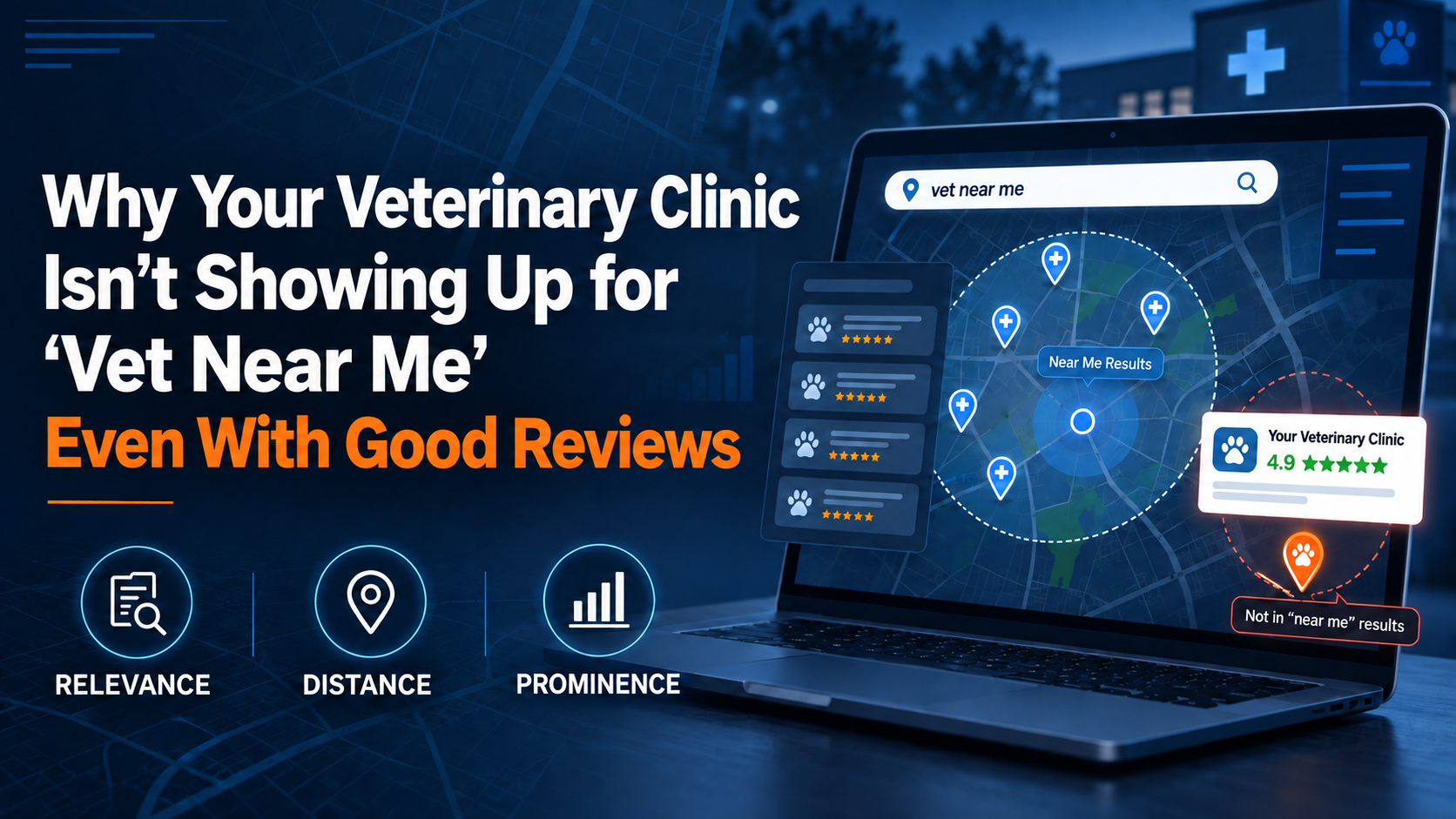
You've got the reviews. Four hundred of them, sitting at 4.8 or 4.9 stars. You respond to every one. Your team is good, your clients say so publicly, and you still open Google Maps, search "vet near me" from your own parking lot, and watch three other clinics show up before yours does.
That's not a glitch, and it's not a sign your reviews don't count. It's a sign you're measuring the wrong thing. Reviews are real evidence of a good clinic. They are not the mechanism that decides who Google shows first.
What Google actually ranks on
Google is direct about this. Its own guidance on local ranking factors names three inputs, and only three:
Reviews sit inside prominence, and Google says so directly: "More reviews and positive ratings can help your business's local ranking." Notice the word help. Reviews are one contributor to one of three factors. A clinic with fewer, weaker reviews can still outrank you on relevance or distance alone.
That's why a well-reviewed general practice can lose a "vet near me" search to a closer clinic, an urgent-care hospital with a tighter category match, or a specialty practice that answers the query more precisely. None of that is a reviews problem. Chasing more five-star ratings won't fix a distance or relevance gap, and it isn't the whole local-search strategy.
"Vet near me" isn't one ranking. It's a different ranking for every searcher.
Your clinic doesn't have a fixed position in "vet near me" results. It has as many positions as there are searchers, because distance resets with every search.
Test this yourself and the pattern shows up fast: a clinic can sit at the top of the Map Pack for someone standing outside its front door and disappear entirely for someone four miles away, even in the same city. That pattern holds across markets of every size: independent hospitals, nonprofit and lower-cost clinics, urgent-care and emergency hospitals, exotic and multispecies practices, chains, and specialty referral hospitals all compete for the same query, and which ones surface depends heavily on where the searcher happens to be standing and what they need.
A few things follow from that:
- A clinic can't fully optimize its way around distance. Being closer beats being better-reviewed, at least within a real radius.
- Testing from your own front desk tells you almost nothing. That search is the one you're most likely to win, and the one that matters least, since your existing clients already know where you are.
- Test from several representative neighborhoods, rather than only your own address, including areas 3, 5 and 10 minutes further out.
- Check the Map Pack and the organic website results separately. "Not showing up" can mean absent from the map listings, absent from the regular blue-link results, or both, and each has a different fix.
Before you touch content: is your profile even eligible to rank?
Before assuming the clinic needs more SEO, rule out a plumbing problem. Google is specific that a profile can be disqualified outright, independent of how good it looks:
- Never claimed or verified
- Suspended or under a policy restriction
- Flagged as a duplicate
- Sitting on an incorrect map pin
- Showing an old address or disconnected phone number
- Missing holiday hours, even if the regular weekly hours are correct
- Linking to the wrong page on your own website
- Split across multiple profiles for the same physical location
That last one matters more than owners expect. Google is explicit: "If you offer different services at your business, do not create separate Business Profiles for each service. Instead, you should list your services on your Business Profile." A separate listing for, say, dental services at the same address doesn't multiply your visibility; it usually gets flagged. Google's duplicate-profile guidance states plainly that "if a profile is considered a duplicate, it won't show on Google Search or Maps" at all. A clinic in that state isn't outranked. It's invisible, and no amount of new content changes that until the underlying profile issue is fixed.
Worth noting: a profile can score 100% on Google's own completeness checklist and still sit in exactly this spot. Completeness and eligibility are different checks entirely, which we covered in more depth in A Complete Google Profile Can Still Be Invisible.
Does Google actually know what kind of vet you are?
Assuming the profile is eligible, the next question is whether it describes the clinic accurately enough for Google to match it to the right searches. Common gaps:
- An overly broad or slightly wrong primary category. "Veterinarian" is not the same match as "Animal Hospital," "Emergency Veterinarian" or "Pet Boarding Service," and the wrong one quietly removes you from the searches you'd actually win.
- Missing secondary categories that would otherwise put you in front of more specific searches, like exotic pet care or dental services.
- Services listed on the website but absent from the Business Profile, or the reverse.
- A general practice competing for a query that's really asking for something narrower: urgent care, an emergency vet, an exotic-animal specialist, where a more precisely matched competitor wins regardless of review count.
Google gives eligible businesses room to fix this directly on the profile. Its guidance on managing services confirms clinics can add specific services, group them into categories, and include descriptions and pricing where relevant, so the profile reflects the actual scope of care offered rather than a generic label.
The websites that showed up had these things in common
The clinics with strong visibility in the local results weren't relying on their Business Profile alone. Their websites consistently included:
- "Veterinarian," "veterinary hospital," or a named specialty stated clearly, with city and state in titles and headings
- Full address, phone number and hours, not buried in a footer
- A dedicated page for each real service: wellness care, vaccinations, dentistry, surgery, diagnostics, urgent care
- Online booking and a call button that works reliably from a phone screen
- Same-day, walk-in, weekend or urgent-care availability stated where it's true
- Veterinarian and team profiles with actual credentials
- Reviews and testimonials placed where an actual visitor reads them, not buried where only Google sees them
- Named neighborhoods or communities served
- Maps, directions and parking details
- New-client forms and onboarding information
None of them were relying on reviews to do the work the website itself should be doing.
One technical note: LocalBusiness structured data (or a veterinary-specific subtype) can help Google parse your address, hours, phone number and departments cleanly. Google's own Search Central documentation is careful to say it "does not guarantee that features that consume structured data will show up in search results." Add it because it clarifies what your business is, not because it's a ranking shortcut.
If a clinic operates more than one location, each real location needs its own page and, in most cases, its own verified profile, with genuinely unique content. A city name swapped into a copy-pasted template reads as thin to both Google and the pet owner reading it.
Prominence is bigger than your star rating
Reviews are doing two separate jobs, and it's worth keeping them apart:
- They contribute to prominence: one input among several that shape how "known" Google judges your clinic to be.
- They persuade the pet owner who already found you to actually pick up the phone.
A 4.9-star rating handles job two extremely well. It doesn't override a distance disadvantage or an unclear category, which is job one's territory. Keep the review habit going anyway: a steady, ethical request process, no gating reviews by star rating before they're posted, prompt and professional responses, and regular monitoring for the kind of feedback that flags a real operational issue. Just don't mistake a strong rating for a complete visibility strategy, and don't stuff service keywords into review requests hoping it moves the needle. It doesn't, and it reads as manufactured to anyone who notices.
The rest of prominence comes from being confirmed in places Google doesn't control: accurate listings on veterinary-relevant directories, mentions from local news or community organizations, links from shelters, rescues and animal welfare groups you actually work with, and a name, address and phone number that match everywhere they appear. This is about real relationships and accuracy, not a mass submission to hundreds of low-quality directories.
Match the clinic to what the searcher actually needs right now
"Vet near me" carries different intent depending on when and how it's typed. The sampled results leaned hard on signals like these:
|
Signal searchers look for |
What it tells Google |
|---|---|
|
Open now |
The clinic can help with something happening today |
|
Open seven days / weekends |
Availability outside a standard Monday-to-Friday window |
|
Same-day appointments |
Fast access, not a multi-week wait |
|
Walk-ins accepted |
No appointment required for a simple concern |
|
Emergency or urgent care |
The clinic can handle something acute, beyond scheduled wellness visits |
|
Low-cost or nonprofit care |
Price is the deciding factor for this searcher |
|
Exotic or multispecies care |
The pet isn't a cat or dog, and most general practices are ruled out immediately |
A general practice with excellent reviews is simply not the right answer to "vet near me" typed at 10 p.m. by someone whose dog just ate something it shouldn't have. That's not a ranking failure. It's a mismatch between what the clinic offers and what that specific search means. Test "vet near me" alongside the variants your clinic actually serves ("emergency vet," "cat veterinarian," "pet dental care," "low-cost vet") and make sure your hours, species treated and real capabilities are stated accurately everywhere, rather than left for the searcher to guess.
Ranking higher doesn't matter if the click doesn't turn into a call
This is the step ranking-focused advice tends to skip. Getting found is not the goal; getting booked is. Once someone lands on your profile or website, they need to be able to, immediately and without hunting:
- Call you from a mobile device with one tap
- Book or request an appointment online
- Confirm today's hours and your exact location
- See whether new clients are accepted
- Tell whether you handle emergencies
- Find pricing, payment or insurance guidance where that's relevant
- Get directions and know what parking looks like
- See real credentials: names, degrees, certifications, beyond a stock team photo
A clinic can genuinely improve its rankings and see zero change in new-client calls, because the page it sent people to didn't answer any of the above. Track qualified calls, booking submissions, direction requests and new-client appointments alongside ranking position. Ranking movement without appointment movement means the visibility work isn't finished yet.
What to check, in order
|
What you're seeing |
Likely cause |
Check this first |
|---|---|---|
|
You rank well next door, vanish a few miles out |
Distance |
Search from 3-5 representative neighborhoods instead of only your own address |
|
Profile looks complete, still no visibility |
Eligibility problem |
Claim/verification status, suspension notices, duplicate flags in Business Profile Manager |
|
You show for your clinic's name, not for "vet" or "animal hospital" |
Category or relevance mismatch |
Primary category accuracy, missing secondary categories, service list on the profile |
|
You rank in the Map Pack, but the website barely shows in organic results |
Website relevance gap |
Dedicated service and location pages, titles, headings, structured data |
|
Reviews are strong, but calls haven't followed |
Conversion gap, not a visibility gap |
Call buttons, booking flow, hours, new-client and emergency info on the landing page |
|
You rank for "vet near me" but lose the emergency or exotic-pet search |
Intent mismatch |
Whether hours, species treated and urgent-care capability are stated accurately |
|
Multiple locations, unclear which one shows |
Duplicate or thin location pages |
One verified profile and one unique page per real address |
No legitimate fix guarantees a permanent top spot
Every item above moves the odds. None of them, together or alone, locks in a fixed position, because distance resets with every searcher and competing clinics keep moving too. Treat local visibility as an ongoing pattern to manage, not a box to check once.
If it's unclear which of these is actually holding your clinic back, that diagnostic work, checking eligibility, category accuracy, on-site relevance and the conversion path before recommending anything, is the starting point of our SEO service for veterinary clinics. It's built specifically around how pet owners search and how clinics actually book new clients, not a generic local-SEO checklist applied to a veterinary practice after the fact.
If you would like to identify the biggest gap before deciding what to change, request a free Search Visibility Snapshot for your clinic.
FAQs
A clinic with fewer reviews outranks mine. How? Reviews are one input into prominence, which is one of three ranking factors. A closer clinic, or one with a more precise category match, can outrank a better-reviewed clinic on relevance or distance alone.
How close does a searcher need to be for my clinic to show up? There's no fixed radius. It varies by market density and by how much competing clinics have built up relevance and prominence. Test from several points across your service area rather than assuming one number.
Is my Business Profile category correct? Check whether your primary category is the most specific accurate match ("Animal Hospital" or "Emergency Veterinarian" versus a generic "Veterinarian"), and add secondary categories for real specialties like exotic or dental care.
Do I need a separate page for every service? Yes, for anything a pet owner might search on its own: wellness care, vaccinations, dentistry, surgery, diagnostics, urgent care. A single page trying to cover everything gives Google less to match against specific searches.
Should every location have its own page and profile? Yes. Each real address needs its own verified Business Profile and its own unique website page. Duplicate profiles for the same location, or a copy-pasted city page, both work against visibility rather than for it.
What's the difference between Maps and organic rankings? The Map Pack and the regular organic results are ranked separately. A clinic can show strongly in one and barely appear in the other, so both need to be checked on their own.
Can structured data make my clinic rank higher? No. Google states directly that structured data doesn't guarantee a ranking or feature boost. It helps Google parse your address, hours, phone number and departments more accurately, which supports relevance rather than causing it.
What should I fix first? Rule out an eligibility problem (unclaimed, suspended, duplicate, wrong pin) before anything else. Then check category accuracy, then the website's service and location pages, then the conversion path on the page itself.
How do I know if better visibility is actually producing appointments? Track qualified calls, booking submissions, direction requests and new-client appointments over time, alongside ranking position. Rankings moving without those numbers moving means the job isn't done.