|
Page Type |
Answers |
Built for |
|
|---|---|---|---|
|
Service page |
What do you do? |
|
|
|
Location page |
Where can I visit you? |
|
|
|
service-area page |
Do you come to my area? |
|
Service Page vs. Location Page: What Independent Businesses Actually Need
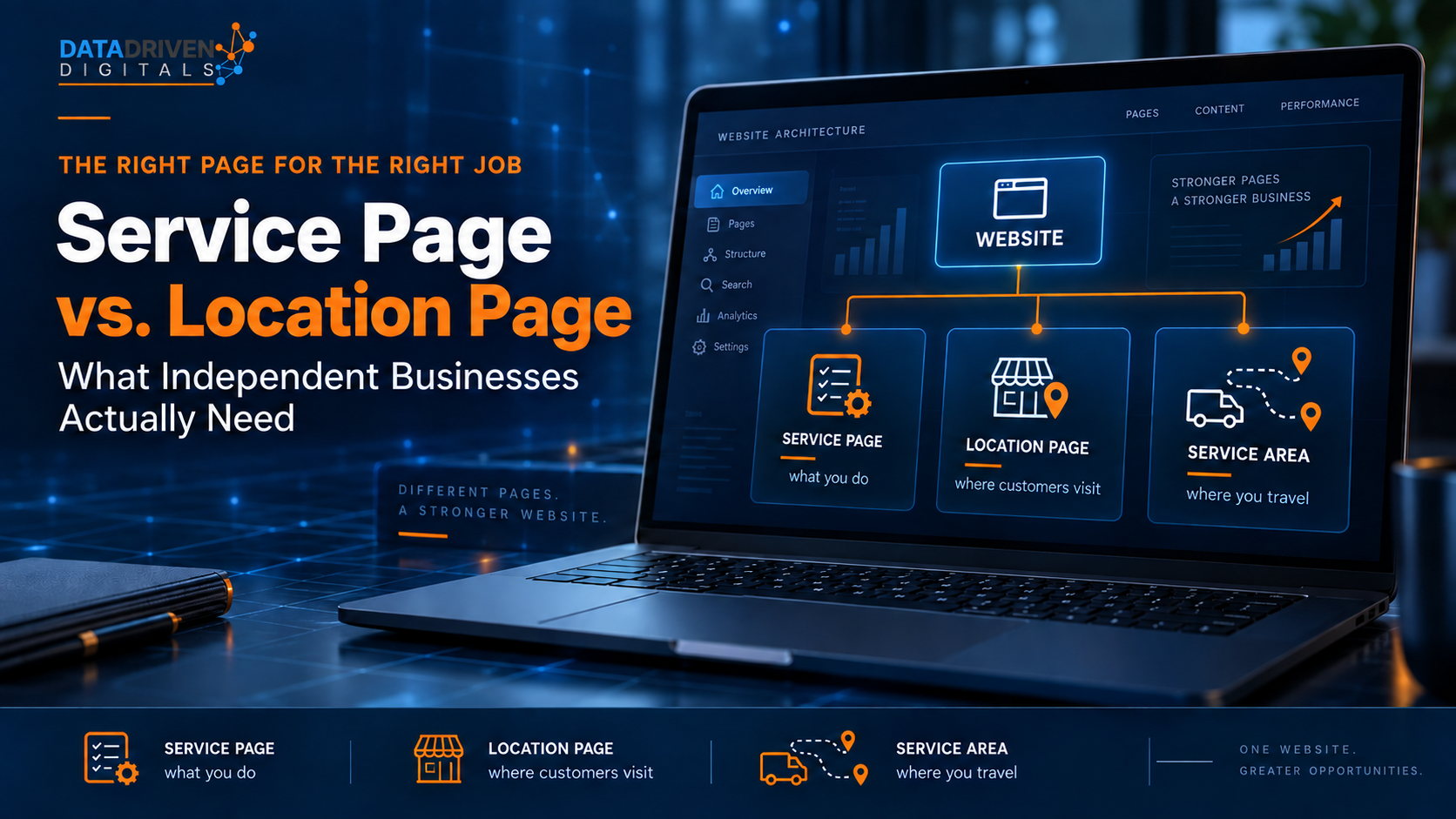
Search for advice on service pages versus location pages and you will find plenty of formulas: one page per service, one page per city, or every possible service-and-city combination.
Independent businesses rarely need that many pages.
The right structure depends on what customers are trying to find, how the business actually operates, and whether each page can provide a useful answer of its own. A service page and a location page are not competing options. They perform different jobs.
Some businesses need all three page types. Some need only strong service pages and a clear contact page. The goal is not to reach a predetermined page count. It is to give each important customer question one clear destination.
Website pages and Google Business Profiles follow different rules
This distinction matters because two different systems are often mixed together.
Your website can have multiple service, location, and service-area pages when each one is useful and accurate. A Google Business Profile represents an eligible business location or service-area business in Google Maps and local results. It does not set the number of pages your website may have.
In general, a business should have one eligible Business Profile for each real location. An additional profile is appropriate only when there is another qualifying, staffed location. Publishing a city page on a website does not create a physical presence in that city or justify another Business Profile.
Google's Business Profile guidelines explain how storefront, service-area, and hybrid businesses should represent their locations. Follow those rules for the profile. Use customer intent and useful content to decide the website structure.
Which pages your business actually needs
Use the operating model as the starting point.
|
|
|
|||
|---|---|---|---|---|---|
|
|
|
|||
|
|
|
|||
|
|
|
|||
|
|
|
|||
|
|
|
A single-location business does not automatically need a separate location page. If the homepage and contact page already provide everything a visitor needs to plan a visit, another city-focused page may only duplicate them.
What Google's rules actually say
Google's guidance supports a simple principle: represent the business as it exists, and create content for people rather than search rankings.
One eligible profile per business location
Google says not to create more than one Business Profile for each business location. A company with three eligible branches may have a profile for each branch. A company that delivers to three neighborhoods does not gain three locations by listing those neighborhoods on its website.
Again, this is a Business Profile rule, not a website page limit. Read Google's representation guidelines.
Storefront, service-area, and hybrid businesses are different
A service-area business visits or delivers to customers and does not serve them at its address. Its address should be hidden on its Business Profile. A hybrid business both serves customers at its address and travels to them. Its address can appear if the location meets Google's requirements and customers can actually visit during stated hours.
Do not publish an address or location page that implies a customer-facing office when no such location exists.
Repetitive city pages can cross the line
Google's spam policies identify doorway abuse as pages created to rank for similar queries that funnel visitors toward the same destination. The policies also cover scaled content created primarily to manipulate rankings rather than help people.
That does not mean every similar city page receives a formal penalty. Search systems may consolidate, ignore, or rank repetitive pages poorly. At scale, pages created mainly to capture city-keyword variations may also meet Google's definitions of doorway or scaled content abuse.
Organic search and the Local Pack are related, but not the same
Website pages primarily compete in organic search. Google Business Profiles power much of the business information shown in Maps and the Local Pack.
Google says local results are mainly based on relevance, distance, and prominence. A useful website can strengthen relevance and prominence, but a city page cannot manufacture proximity or override the searcher's distance from the business. See Google's explanation of local ranking.
This is why a service-area page may earn organic visibility for a useful local answer without causing the business to appear in the Local Pack as if it had an office there.
Does every service need its own page?
No. Create a dedicated service page when the service is commercially important, has distinct search or customer intent, and can support a genuinely useful explanation.
A strong service page usually covers:
- The problem the service solves and who it is for
- What is included and what is not
- The process and what customers should expect
- Pricing guidance, ranges, or the factors that affect price, where appropriate
- Common questions or concerns before booking
- Relevant proof, such as reviews, outcomes, credentials, or project photos
- One clear next step, such as calling, booking, or requesting a quote
Related minor services may be clearer on one well-organized page. Splitting a short list into several thin pages does not improve the customer experience.
Do you need service-plus-city pages?
A page such as “water heater repair in a specific city” can be useful when the service and location combination creates a distinct customer need. It should not be the automatic next step for every service in every city.
Before creating one, ask:
- Is there meaningful customer demand for this service in this area?
- Is the market important enough to the business to maintain the page?
- Will the page answer something the main service page and service-area page do not?
- Can the business reliably provide the service there?
- Is there enough useful information to make the page specific without padding or invented local details?
- Can results be measured through search visibility and actual leads?
If the answer is mostly no, link a strong service page to a useful service-area page instead. Most independent businesses do not need a complete services-by-cities matrix.
The page-multiplication mistake
A common pattern starts with the advice that more city pages mean more chances to rank. The business publishes fifteen pages with the same introduction, service list, testimonials, and call to action. Only the city name changes.
Those pages provide little reason for a person or a search engine to choose one over another. They may be consolidated, ignored, or rank poorly. They also create a maintenance problem: prices, services, staff information, and claims can become inconsistent across the site.
Useful local content can include service availability, travel or response details, regulations, property conditions, customer questions, or real project evidence that is relevant to the area. Do not add a landmark, neighborhood, client story, or photograph merely to make a page look local. Every detail should be accurate and helpful.
A practical test is to remove the city name and reread the page. If nothing else distinguishes the market or answers a local question, the page may not deserve to exist separately.
A page underperforming and an entire Business Profile being difficult to find are different problems. If the profile itself seems invisible, see A Complete Google Profile Can Still Be Invisible.
What belongs on a location page
A true location page helps someone choose and visit a specific branch. Include:
- The exact business name, address, local phone number, and hours
- Services available at that branch
- Real photos of the location, team, or work
- Directions, parking, public transit, accessibility, or entry details
- Branch-specific reviews, credentials, or frequently asked questions
- A booking link, phone number, or other direct call to action
- A link to the corresponding Google Business Profile when useful
If every branch has the same copy except for the address, the pages are not doing enough work for customers.
What belongs on a service-area page
A service-area page should make it clear that the business travels to or serves customers in the area. It should not imply a storefront or local office that does not exist.
Include:
- A clear statement explaining how the business serves the area
- The services available there, with links to the main service pages
- Coverage, delivery, scheduling, or response details that affect customers
- Real local projects, reviews, or photographs when available
- Area-specific conditions, restrictions, or questions when they genuinely matter
- One direct call to action
Previous jobs in a market are valuable proof, but they are not an absolute requirement. A business entering a new market may create a page if it truly serves the area and can provide useful, accurate information. Invented experience is never acceptable.
How the pages should fit together
Keep the architecture easy for customers and search engines to follow. For example:
/services/emergency-veterinary-care//locations/charlotte-nc//service-areas/mississauga/
Location and service-area pages should link to the services available there. Service pages should link to applicable branches or areas when that helps a visitor take the next step. A locations or service-areas hub can make a larger set easy to browse and crawl.
Each page should still have one primary job. If several pages compete to answer the same query with the same information, consolidation may be more useful than another internal link.
Do these pages help a business appear in AI answers?
There is no separate “AI version” of a service or location page. Google's guidance for appearing in AI search experiences continues to emphasize helpful, reliable content that is accessible and indexable. Google's AI search guidance recommends the same fundamentals used for traditional search.
Structured data can help Google understand information already visible on a page, but it does not guarantee rankings, rich results, or citations. LocalBusiness structured data may be appropriate for accurate business and location details. The markup must match the content customers can see. See Google's LocalBusiness documentation.
Clarity helps both people and machines: one focused page, specific claims, consistent business details, and evidence that supports what the page says.
Five independent businesses, five different answers
|
|
|||
|---|---|---|---|---|
|
|
|||
|
|
|||
|
|
|||
|
|
|||
|
|
Mistakes that cost independent businesses visibility
- Treating a website city page as proof of a physical location
- Creating a Business Profile for every city served
- Copying one template and changing only place names
- Publishing every possible service-and-city combination
- Hiding a real storefront address or displaying a private service-area base incorrectly
- Skipping service pages and expecting the homepage to explain every offering
- Adding unsupported local claims, reviews, photographs, or landmarks
- Using structured data that does not match the visible page
- Launching more pages than the business can keep accurate
How to measure whether the structure is working
Page count is not the goal. Useful visibility and qualified leads are.
Review:
- Whether Google indexes the intended pages
- Which queries and pages earn impressions and clicks in Google Search Console
- Whether similar pages keep swapping positions for the same queries
- Calls, forms, bookings, or purchases attributed to each page
- Whether visitors reach the right service and location information
- Which pages receive little visibility, engagement, or business value
- Whether the team can keep every page accurate as services, hours, and coverage change
If several pages compete for the same intent or add no measurable value, improve, combine, redirect, or retire them based on the evidence.
A practical checklist
- Count the real, staffed, customer-facing locations
- Decide whether visit information belongs on the homepage, a contact page, or a dedicated page for each branch
- List the distinct, commercially important services that can support useful content
- Select service areas based on demand, business priority, real operational coverage, and available information
- Avoid building a full services-by-cities matrix by default
- Make every location and service-area claim accurate
- Link related service, location, and service-area pages logically
- Keep Business Profile information consistent with how the business actually operates
- Add relevant structured data only after the visible content is correct
- Measure search performance and leads at the page level
- Remove or consolidate pages that do not serve a distinct purpose
FAQs
Do I need both service pages and location pages?
Not always. Most businesses benefit from strong pages for their important services. A separate location page is useful for each real branch, but a one-location business may already cover its visit details well on the homepage or contact page. A mobile business without a customer-facing address usually needs service pages and selected service-area pages instead.
How many location pages should I have?
Usually one per real, eligible, staffed location that customers can visit. Do not create a location page merely because a city is part of the service radius.
Can I create pages for areas where I do not have an office?
Yes, if they are honest service-area or market pages and provide a useful answer for people there. Do not imply an address, local team, or physical presence that does not exist.
Do I need previous customers in an area before creating a service-area page?
No. Real projects and reviews strengthen a page, but a new market can still justify a page when the business genuinely serves it and has useful, accurate information for customers there.
Will near-duplicate city pages get a site penalized?
Not necessarily. Search systems may consolidate, ignore, or rank them poorly. At scale, pages created mainly to rank for similar city searches can also fall under Google's doorway or scaled content abuse policies.
Should a business address be hidden on Google?
A genuine service-area business that does not receive customers at its address should hide it. A qualifying storefront or hybrid business may display its address when customers can visit there during its stated hours.
Does structured data make a page rank or appear in AI answers?
No. Structured data can help search systems understand visible information, but it does not guarantee rankings, rich results, or citations.
What should a new website build first?
Start with the pages closest to revenue and customer decisions: the homepage, important service pages, and accurate visit or service-area information. Add more pages only when each one has a distinct purpose and can be maintained.
If it is still unclear which pages a business needs, DDD's free Search Visibility Snapshot can identify whether service clarity, page structure, location relevance, or the conversion path appears to be limiting visibility.