|
What the data shows |
Why it matters to you |
|---|---|
|
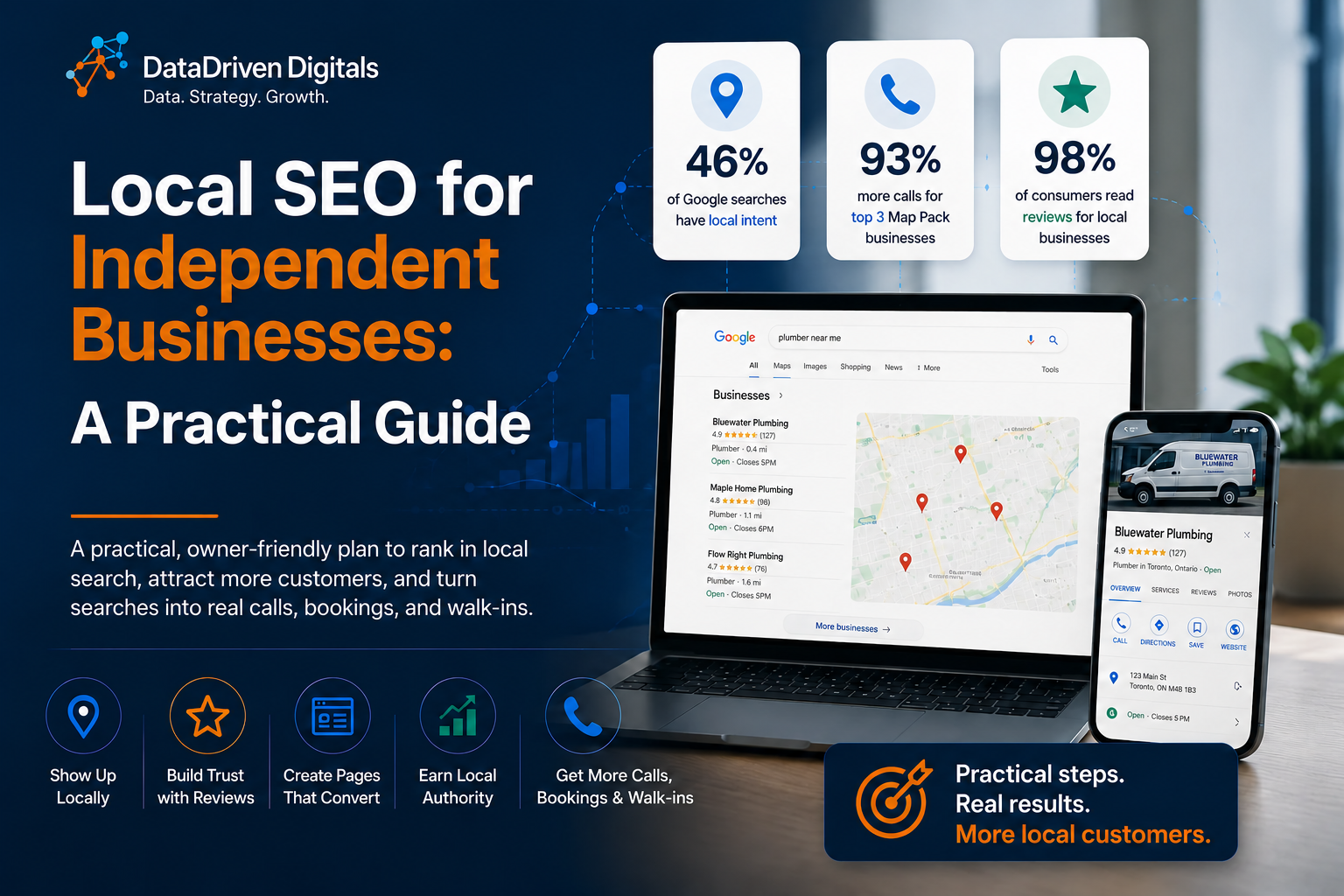
About 46% of Google searches have local intent, according to BrightLocal’s local SEO statistics. |
Local search is relevant to customers looking for nearby services. |
|
BrightLocal’s 2026 Consumer Review Survey reports that 97% of consumers read reviews for local businesses and 41% always do. |
Reviews help prospective customers evaluate a business before contacting it. |
Local SEO for Independent Service Businesses: A Practical Guide
You run the business, do the work, and answer the phone. Marketing gets whatever time is left over — which usually isn't much. The good news: winning local customers comes down to a handful of clear, repeatable moves. The hard part isn't knowing what they are; it's doing them consistently while you're also running the business.
This guide gives independent service businesses a practical plan to improve how they appear in local search and turn visibility into inquiries. It covers your Google Business Profile, service and location pages, reviews, local links, and measurement. Google says its AI search features use the same foundational SEO practices; there is no separate AI-search shortcut.
Do these 5 things this week
Start with these practical checks. They can help you find accuracy and content gaps, but the time required and results will vary by business.
- Fix your Google Business Profile category and hours. Set the most accurate primary category, add holiday hours, and confirm your service area.
- Upload 5 fresh photos of your team, your work, and your finished results — real photos, not stock.
- Ask customers for an honest review using your direct Google review link. Ask consistently, don’t offer incentives, and don’t suggest what customers should write. See Google’s review guidance.
- Make your name, address, and phone (NAP) identical everywhere — website, Google, Bing, Apple, the major directories.
- Publish or upgrade one service page that answers what the job costs, what's included, and what happens when they book.
What changed in local search (and what didn't)
Google says local results mainly reflect relevance, distance, and prominence. Search now includes AI features, but Google’s guidance says the same SEO fundamentals apply. Pages must meet normal Search eligibility requirements to appear in AI features, and eligibility does not guarantee inclusion. Read Google’s AI-feature guidance.
Industry studies can help show how search is changing, but their results depend on the queries and industries measured. For example, BrightEdge’s findings, reported by Search Engine Journal, describe results from a tracked query set, not a universal rate for local searches.
Why it's worth the effort
Local search isn't a vanity project; it's where service customers actually are.
How Google ranks you: the signals that decide it
Google says local results mainly reflect relevance, distance, and prominence. Relevance is how well a profile matches a search; distance is how far a business is from the searcher; and prominence reflects how well-known a business is. Google says reviews and links can contribute to prominence. See Google’s explanation of local ranking.
BrightLocal surveys local SEO experts about the factors they believe influence rankings. Its 2026 Local Search Ranking Factors study is useful as industry perspective, but its percentages are expert estimates—not ranking weights published by Google.
|
Signal Group |
Approx. Weight |
What it covers |
|---|---|---|
|
Google Business Profile |
~32% |
Categories, completeness, posts, photos, activity |
|
On-page content |
~19% |
Service & location pages, titles, structure, schema |
|
Reviews |
~16% |
Recency, velocity, rating, detailed text |
|
Links |
~15% |
Local, relevant sites linking to you |
|
Behavioral |
~8% |
Clicks, calls, direction requests, time on profile |
|
Citations |
~7% |
Consistent NAP across directories |
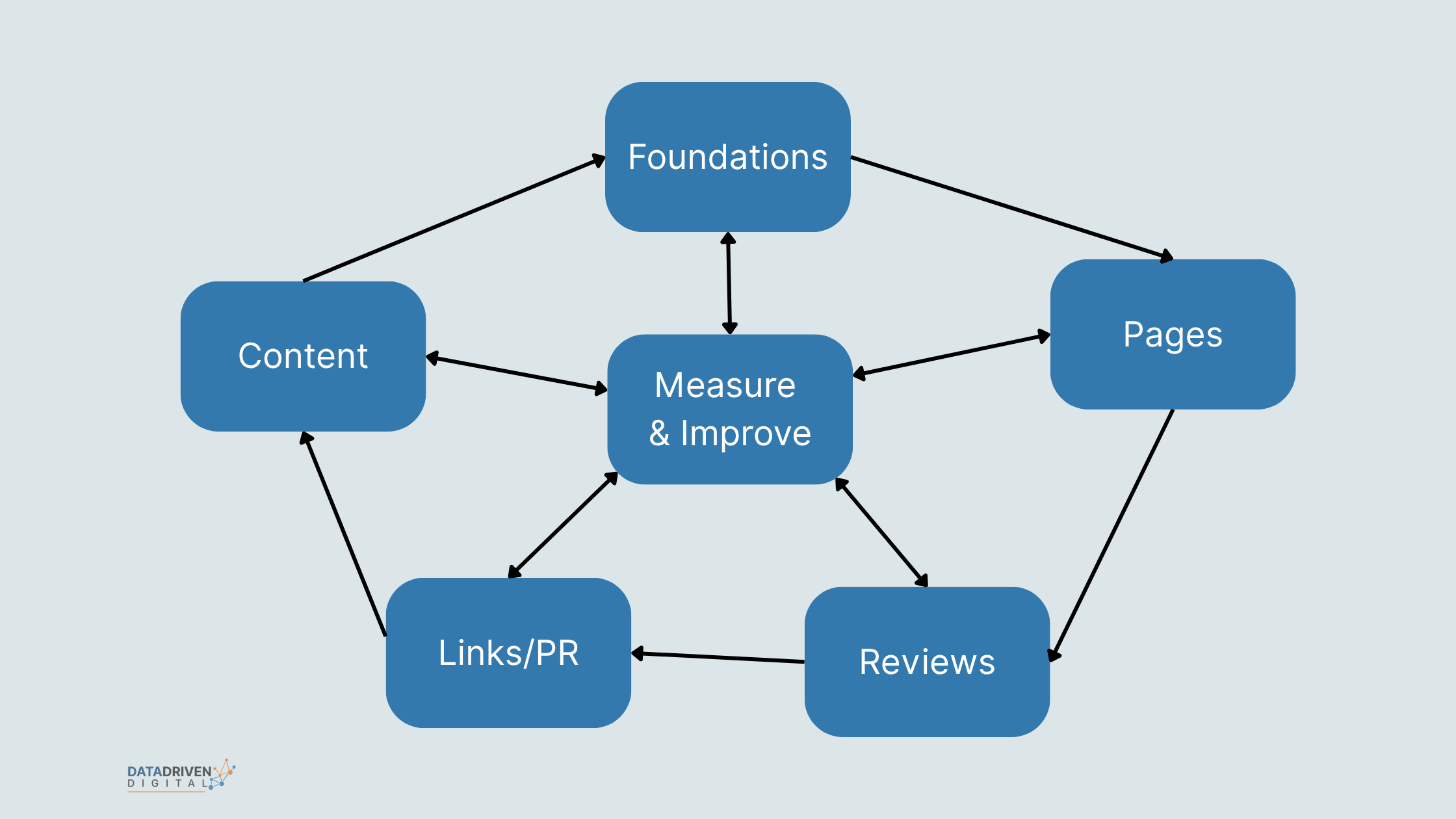
The 5-Stage Plan (first 90 days)
Stage 1 — Foundations (Weeks 1–2)
Audit and prioritize
- Create one "NAP master record": your exact business name, address, phone, and hours, written once and copied everywhere.
- Check how you rank for your brand name plus 10 non-brand service terms (e.g., "furnace repair [city]").
- Confirm Google Analytics (GA4) and Google Search Console are installed and verified.
- Pick the 10 highest-impact fixes for the next 90 days and ignore the rest for now.
Google Business Profile setup / refresh
- Choose the most accurate primary category and add relevant secondary categories where appropriate.
- Keep your business description, services, attributes, hours, and service-area settings accurate and complete.
- Add genuine photos that help customers understand your team, work, and location.
- Share useful updates when you have news or information customers need; don’t treat posting frequency as a guaranteed ranking factor.
- Turn on messaging only if you can respond reliably.
NAP consistency and core citations
- Claim and clean Google, Apple Business Connect, Bing Places, and Yelp first.
- Add the directories that matter for your trade — Healthgrades/Vitals for dental and medical; Angi, Thumbtack, HomeStars, or Nextdoor for home services and trades.
- Keep your core business details accurate across your website and important listings. This helps customers confirm they have found the right business; don’t treat consistency as a guarantee of inclusion in AI results.
- Keep a living spreadsheet of every listing and recheck it quarterly.
Stage 2 — Pages that convert (Weeks 2–4)
Service pages — one per service
Each should cover: who it's for, the problem it solves, your process step by step, pricing guidance ("starting at" or a range), FAQs, proof (reviews and photos), and a strong Call / Book button. Use the URL pattern /services/<service> and link it from your homepage and related services.
Location / service-area pages — one per city you actually serve
Create a location or service-area page when you genuinely serve that area and can provide useful, distinct information for its customers. Don’t create near-identical pages just to target more city names. For help deciding which page type fits, see our service page vs. location page guide.
On-page essentials
- A clear title and H1, with scannable H2s written as the questions customers actually ask.
- Use structured data only when it accurately describes visible page content. Google’s AI-feature guidance does not require special AI schema, and structured data does not guarantee AI citations.
- Compressed images with descriptive alt text, and a tap-to-call phone number on mobile.
Stage 3 — Reputation and proof engine (Weeks 4–6, then forever)
Reviews can help customers assess a business, and Google says review quantity and positive ratings can contribute to prominence. There is no published monthly review target or required response time. Google’s local ranking guidance explains the ranking factors; Google’s review guidance covers review requests and responses.
Reviews program
- Ask customers for honest feedback and make it easy to leave a review.
- Don’t offer incentives, selectively ask only customers you expect to be positive, or tell customers what to write.
- Respond to reviews clearly and professionally. Address the customer’s concern without sharing private details.
Before/after and mini-cases
- Capture 3 photo sets a month with 80–120 word captions describing the work.
- Post them to your profile and the relevant service/location page; reuse on social and your newsletter.
- Tag each by service and by city to build local relevance.
Stage 4 — Local links and community signals (Weeks 6–10)
- Easy wins: chamber of commerce, trade associations, supplier and partner "find a provider" pages.
- Community: sponsor a youth team or local event, then write a short story with photos on your site.
- Local PR: pitch small, useful stories quarterly — a new service, a seasonal checklist, a donation drive — with a local stat, a quote, and a photo to make coverage easy.
Stage 5 — Content that helps customers make decisions (Week 8+)
Publish useful local content when you can answer a real question customers ask before they book. Useful content can support discovery, but no format guarantees that a search feature or AI tool will quote your business.
What to publish:
- "How to choose" guides — "How to Choose a Furnace Repair Company in [City]: 5 Questions to Ask First."
- Transparent pricing explainers — "What Does a Dental Cleaning Cost in [City]? What Affects the Price."
- "What to expect" walk-throughs — "Your First Visit: Timeline, Comfort, and Results."
- Seasonal checklists for your region — "Pre-Winter Furnace Tune-Up Checklist for [Region] Homes."
How to make it useful:
- Answer the customer’s question clearly.
- Explain the steps, choices, or costs they need to understand.
- Add local details only when they are accurate and helpful.
- Link to reliable sources when you make factual claims.
- Give the reader a relevant next step, such as calling, booking, or requesting a quote.
Google’s guidance on AI features says the same foundational SEO practices apply.
How local SEO relates to AI search
Google says the same SEO fundamentals apply to AI Overviews and AI Mode. A page must be indexed and eligible to appear with a Search snippet, but that does not guarantee it will be shown in an AI feature. There is no special schema requirement or formula for earning a citation. See Google’s AI-feature guidance.
For an independent service business, focus on accurate business details, useful service information, and pages that answer customers’ questions. Keep your Google Business Profile information accurate, and measure business outcomes such as calls, bookings, and inquiries.
Measurement: track what pays the bills
Watch the actions that produce revenue, not just traffic.
- KPIs: calls, form fills, direction requests, and bookings — plus Google Business Profile insights, non-brand clicks in Search Console, and page-level conversions.
- Rank tracking: If you use a local grid, choose a small set of priority services and locations as a sample. Rankings vary by searcher location and query, so use the grid as a directional check—not as a measure of every customer’s experience.
- Attribution: dynamic call tracking on your website only (never change the NAP on your profile), UTM tags on your profile posts, tagged links in email.
- Quarterly review: Keep / Change / Start / Stop — then queue the next experiments.
Myths to ignore in 2026
- "More citations always win." Accuracy and consistency beat long lists of weak directories.
- "Stuff the city name into every heading." Write for people; add the city where it's genuinely useful.
- "One locations page covers all my cities." It covers none of them. One real page per city.
- "Reviews don't affect rankings." Google says review quantity and positive ratings can contribute to prominence, and reviews can help customers make decisions. They don’t guarantee AI citations, though. Google’s local ranking guidance.
- "AI killed SEO, so why bother." Google says its AI features use the same foundational SEO practices. However, be mindful: meeting eligibility requirements still does not guarantee that a page will appear. Google’s AI-feature guidance.
Owner’s Checklist
Review this checklist regularly:
- Your Google Business Profile is verified and its details are accurate.
- Your website explains the services you provide and how customers can contact or book you.
- Any location pages reflect places you genuinely serve and offer useful local information.
- Your review requests follow Google’s review guidance.
- Your local links and partnerships are relevant to your business and community.
- You track calls, bookings, forms, and other meaningful inquiries.
- You review visibility and lead trends regularly, then choose the next improvement based on evidence.
FAQs
How long does local SEO take to show results?
There is no reliable timeline that applies to every business. Results depend on factors such as your starting point, competition, and the work completed. Track visibility and inquiries over time rather than relying on a fixed promise.
How many reviews do I need?
There is no universal target or required monthly number. Ask customers for honest feedback without incentives or suggested wording. See Google’s review guidance.
Do I need separate pages for nearby cities?
Yes — if you want to rank and win customers there. One helpful page per city with genuine local proof.
Should I pay for LSA if I’m doing SEO?
If the return is healthy, LSAs can fill the pipeline while your organic presence compounds. Track cost per booked job and avoid depending entirely on pay-per-lead.
How do I appear in AI search answers?
Google says the same foundational SEO practices apply to AI features. Pages must meet Search eligibility requirements, but there is no guaranteed method of inclusion. See Google’s AI-feature
What if a competitor is spammy (name stuffing, fake addresses)?
Suggest an edit or file a redressal request with evidence, and keep building your own legitimate signals — reviews, photos, content, and links win over time.
Will blogging get my business quoted by AI?
A useful article can answer customer questions and support discovery, but no topic, format, or writing structure guarantees that an AI tool will quote it.
This guide is for independent, owner-operated service businesses. Start with the five quick wins, work the 90-day plan in order, and review your numbers every quarter.
Want to understand where your business is showing up and what to improve next? Start with the our Search Visibility Snapshot.