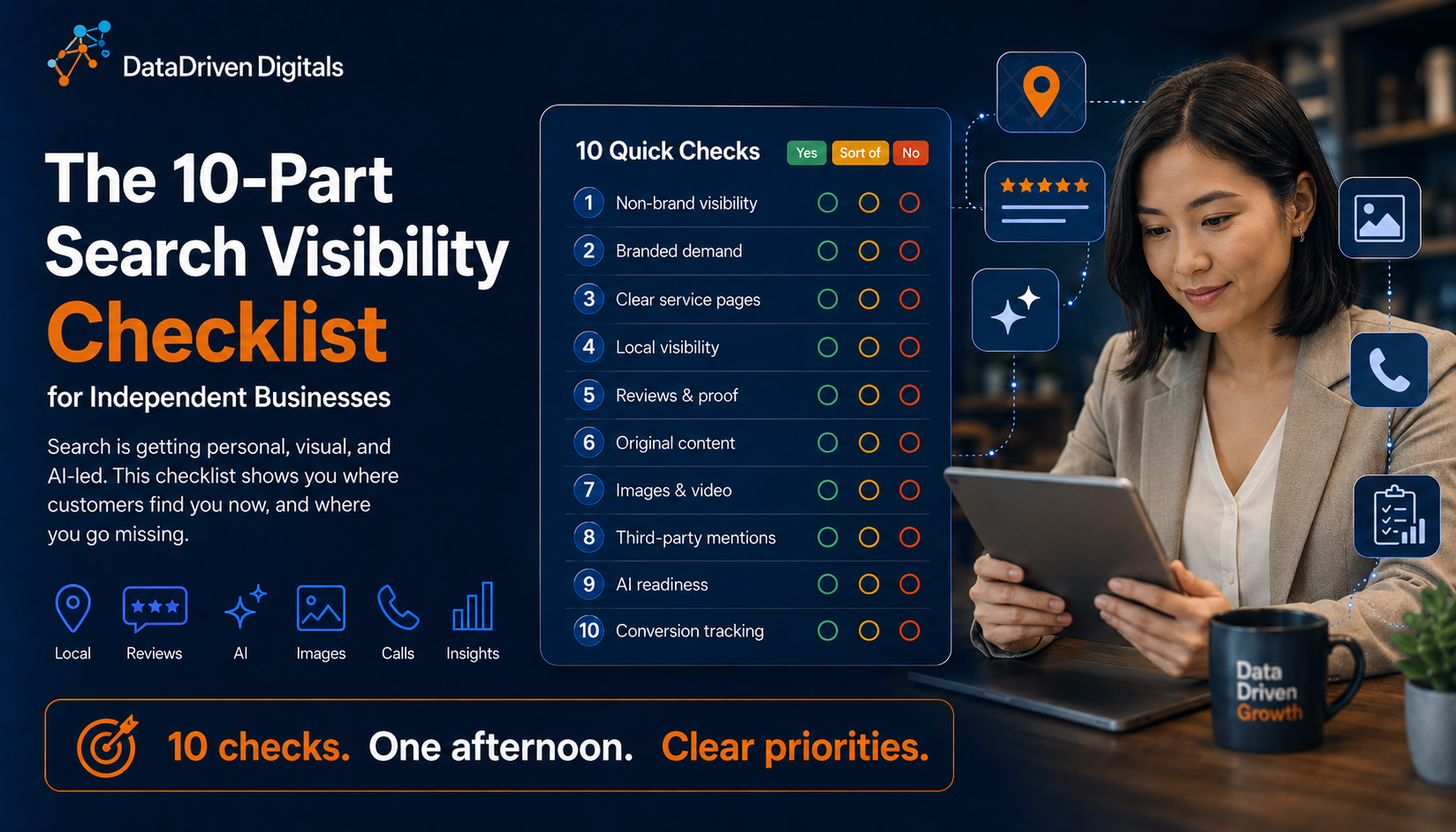
Search is getting personal, visual, and AI-led. This checklist shows you where customers find you now, and where you go missing. Work through it in an afternoon.
Getting found on Google is no longer about one ranking. A customer might meet your business in a map, a review, an AI answer, or a photo they snap with their phone. Miss those spots and you stay invisible, even with a decent website.
Use the ten checks below. Score each one: yes, sort of, or no. Your “no” answers are your to-do list.
1. Non-brand visibility
Can a customer find you before they know your name?
Search your main service plus your town, the way a stranger would. “Emergency electrician Leeds.” If you are nowhere on page one of the map or the links, this is your first job.
Check: You appear when people search the problem, not just your business name.
2. Branded demand
Do people search for you by name?
Branded searches are a strong sign of trust. Google now splits branded and non-branded searches for you inside Search Console, so you can watch this grow.
Check: Your branded searches are climbing month on month.
3. Clear service pages
Does each service have its own page?
One page that lists everything you do is weak. Separate pages for “boiler repair,” “bathroom installation,” and so on give Google and customers a clear answer.
Check: Every core service has a dedicated, detailed page.
4. Local visibility
Is your Google Business Profile working hard?
This is often the first thing a customer sees. Get the basics right and keep them fresh.
Correct primary category
Current hours, including holidays
Real photos of your work, team, and premises
Recent, detailed reviews with your replies
Check: Your profile is complete, current, and active.
5. Reviews and proof
Do other people vouch for you?
Customers trust other customers far more than they trust your own claims. A steady stream of recent reviews beats a pile of old ones.
Check: You have a simple system to ask happy customers for reviews.
6. Original, useful content
Does your site say something only you can say?
AI can rewrite generic advice in seconds. A post titled “5 benefits of clean gutters” helps no one. Real project stories, honest pricing, and lessons from the job stand out.
Each important page should pass one test: what does this offer that other sites do not?
Check: Your best pages share first-hand knowledge, not recycled tips.
7. Images and video
Is your visual content yours?
Search is now full of photos and clips. Google saves what people view and snap through tools like Lens. Stock photos do nothing for you here.
Original photos of real work
Clear file names and alt text
Short videos with titles and captions
Check: Your images and videos are original and properly labeled.
8. Third-party mentions
Does the wider web confirm you exist?
You saying you are great is weak. A trade body, a local paper, a supplier directory, or a “best of” list saying it is strong.
Check: Trusted sites beyond your own mention your business.
9. AI and mention readiness
Can AI answers find and quote you?
Google has confirmed its AI features use the same SEO basics. Your page must be indexed, clear, and trustworthy to get pulled into an answer. No secret trick required.
Check: Your key pages are indexed, clearly written, and easy to quote.
10. Conversion tracking
Can you tell which searches turn into money?
Visibility is pointless if you cannot link it to calls and bookings. Track the actions that pay the bills.
Check: You know which search activity leads to real enquiries.