|
Evidence area |
What we can say with confidence |
Practical action |
|---|---|---|
|
Links and mentions |
Link analysis remains part of Google’s core ranking systems, while genuine third-party coverage can help people discover and evaluate a brand. |
Earn relevant coverage and mentions; do not manufacture them. |
|
Clear authorship |
Google recommends making it clear who created content when readers would reasonably expect that information. |
Add accurate bylines and useful author information where appropriate. |
|
Original experience |
Google recommends unique, non-commodity, people-first content. |
Include first-hand examples, screenshots, original data or clearly described processes. |
|
Accuracy and freshness |
Outdated facts can make otherwise useful content misleading. |
Review time-sensitive claims and display accurate publication and update dates. |
|
Structured data |
Structured data can help Google understand content and determine eligibility for supported search features. |
Use appropriate markup that accurately matches the visible page. |
Trust Signals for Google and AI Search in 2026: What’s Confirmed and What’s Emerging
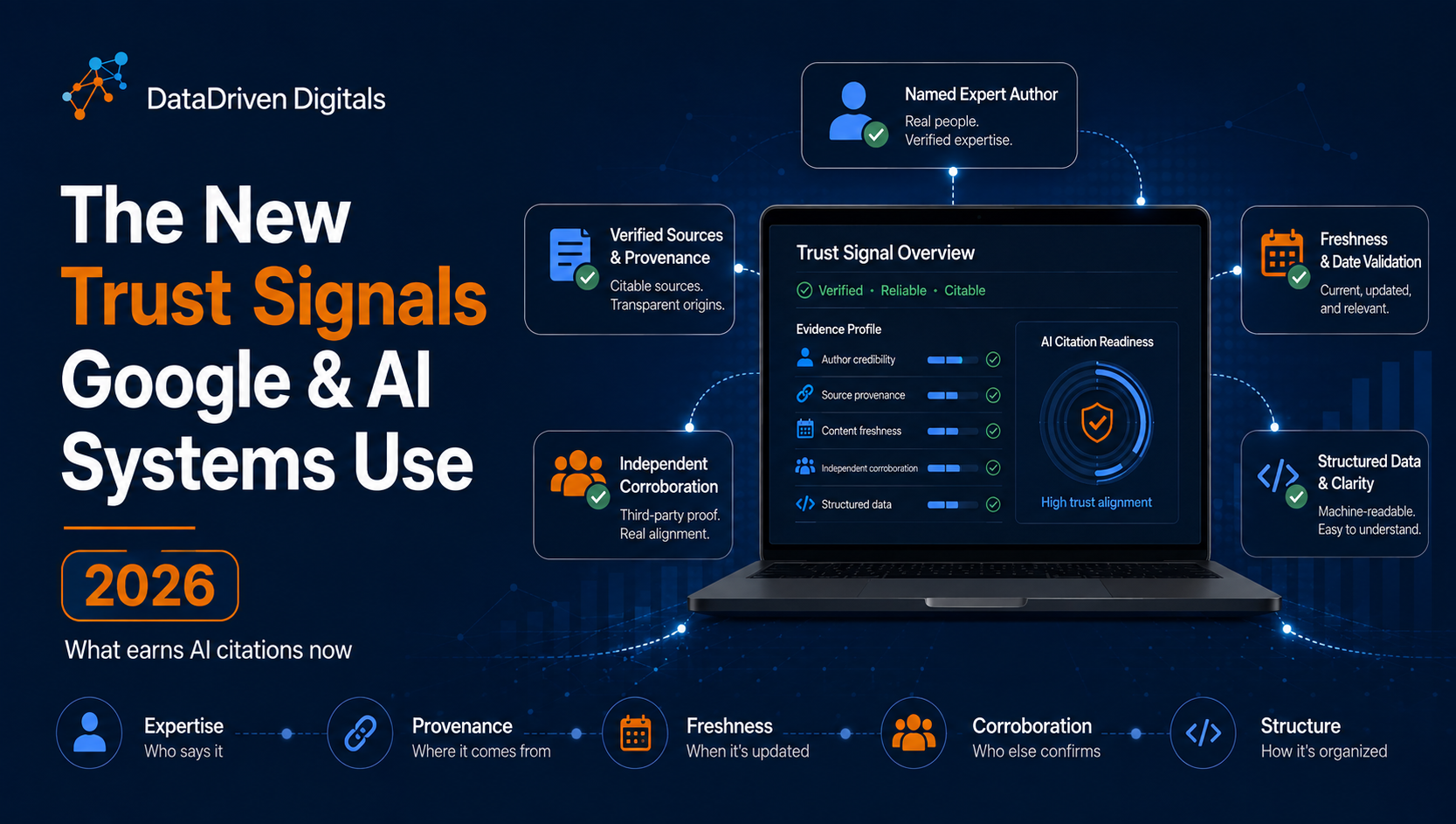
Backlinks still matter, but they are only one part of how search engines discover, evaluate and surface information. Google confirms that link analysis and PageRank remain part of its core ranking systems. In AI-generated search experiences, the strongest practical strategy is not a new trust hack. It is the same foundation Google has emphasized for years: technically accessible pages, useful and original content, clear sourcing, accurate business information and evidence that supports important claims.
Google’s July 2026 update to the Open Knowledge Format, or OKF, is relevant to the broader discussion about provenance and freshness. However, it is not a Google Search ranking or AI-citation specification. OKF was created to organize knowledge used by AI agents, including information such as metric definitions, table schemas and operational documentation.
That distinction matters. Google says that the existing best practices for SEO remain relevant to AI Overviews and AI Mode, with no additional requirements or special optimizations needed to appear. This article therefore separates what Google has confirmed about AI search visibility from what independent citation studies suggest, then turns both into practical actions for business websites.
Why trust now requires more evidence
Traditional SEO signals have not disappeared. Google explains that its generative search features are rooted in its core Search ranking and quality systems. What has changed is how information may be retrieved and presented: a page can now support part of a synthesized response rather than appearing only as a conventional search result.
Google has not published a fixed list of “AI trust signals.” Nevertheless, its documentation and independent research point to several useful areas of focus:
The sections below distinguish confirmed Google guidance from findings in third-party citation research.
1. What Google’s Open Knowledge Format does—and does not—tell us
Google Cloud released version 0.2 of the Open Knowledge Format on July 24, 2026. The update added optional fields that knowledge bundles can use to record sources, generation and verification status, freshness, lifecycle status and attested calculations.
Those capabilities are useful for organizations managing knowledge consumed by AI agents. They reinforce a sensible operational principle: important information should have a traceable source, an owner and a review date.
However, OKF is not part of Google Search’s documented ranking systems. Website owners do not need to implement OKF metadata to appear in AI Overviews or AI Mode. Google’s documentation says there are no additional technical requirements or special optimizations needed beyond ordinary Search eligibility and SEO fundamentals.
For business websites, the lesson is therefore conceptual rather than technical: support consequential claims with evidence, keep changing information current and make accountability clear. Do not treat OKF implementation as an SEO requirement.
2. E-E-A-T remains a useful quality framework
E-E-A-T—experience, expertise, authoritativeness and trustworthiness—remains part of Google’s guidance for creating helpful, reliable, people-first content. Google also encourages publishers to make it clear who created content when readers would reasonably expect that information.
However, Google does not describe E-E-A-T as a single score or a pass-or-fail filter. It is therefore more accurate to treat it as a quality framework than to claim that weak E-E-A-T costs a specific number of ranking positions or automatically excludes a page from an AI-generated answer.
In practice:
- Use an accurate byline and author biography when the creator’s identity and experience matter.
- Demonstrate first-hand experience through examples, screenshots, tests, original data or a clearly described process.
- Support consequential claims with reliable sources.
- Correct substantive errors openly.
- Keep company, contact and service information accurate and consistent.
3. Where cited passages often appear within a page
Two independent 2026 studies examined where cited passages appeared within sampled webpages. Their findings provide useful directional evidence, but they do not establish a universal Google ranking or retrieval rule.
- In CXL’s study of 100 Google AI Overview citations, 55% came from the first 30% of a page, while 21% came from the bottom 40%. This suggests that concise early explanations may be easier to retrieve in some contexts; it does not mean Google ignores the rest of a page.
- In Kevin Indig’s analysis of 18,012 verified ChatGPT citations, 44.2% came from the first 30% of the source text. Indig described the distribution as a “ski ramp” because citation frequency declined after the first third of the document. This supports making important information easy to locate, but it should not be treated as a guaranteed citation formula.
CXL also observed citations from self-contained question-and-answer sections. That supports writing clear answers when FAQs genuinely help readers, but it does not make FAQ sections or FAQ schema a guaranteed citation tactic.
The practical recommendation is simple: give readers a direct answer early when doing so feels natural, then provide context, evidence and nuance. Google explicitly says there is no requirement to “chunk” content into small pieces or rewrite it specifically for generative AI.
4. Independent corroboration can strengthen credibility
Consistent third-party information can help people evaluate a business. Reviews, reputable coverage, professional profiles and relevant forum discussions may provide context that a company’s own marketing cannot.
That does not mean corroboration has replaced backlinks, or that Google has confirmed a simple cross-platform agreement signal for AI citations. Links, mentions, reviews and business information serve different purposes.
The practical goal is accuracy. Make sure important facts—such as services, credentials, locations and pricing—are truthful and consistent wherever they appear. Work toward genuine reviews and relevant coverage, but do not manufacture mentions. Google’s guidance specifically warns that seeking inauthentic mentions is not a shortcut to visibility in generative Search.
5. What does not matter as much as the hype suggests
Two frequently recommended tactics deserve more scrutiny.
llms.txt. For Google Search, an llms.txt file is unnecessary. Google says that Search ignores llms.txt and other AI-specific files, meaning they neither improve nor harm Google rankings or generative-search visibility. Other services may choose to use the file, but most businesses should not prioritize it ahead of crawlability, useful content, internal links and accurate business information.
Structured data as an AI ranking tactic. Structured data remains useful when it accurately describes visible page content and supports an eligible Google search feature. For example, Article structured data can help Google understand an article’s title, images, dates and author information.
However, Google says that structured data is not required for generative AI Search and that there is no special AI schema. Its broader structured-data documentation describes markup as a way to give Google explicit information about a page and establish eligibility for supported search features. Treat it as accurate labeling, not as a ranking button or proven citation multiplier.
6. Google's own transparency features are trust signals too
Google has been giving searchers more context about sources for several years. In 2021, it introduced what became known as About This Result, allowing users to learn more about an unfamiliar source before visiting it. In 2023, Google introduced additional ways to find first-hand experiences and diverse perspectives in Search.
These features demonstrate Google’s effort to give searchers more context about sources and perspectives. It is reasonable to see transparency as part of a better search experience. However, their existence is not evidence that About This Result or Perspectives directly determines which webpages Google’s AI features cite.
Trust signal checklist
|
Priority |
Why it matters |
What to do |
|---|---|---|
|
Helps readers understand who created the content; Google recommends this where readers would expect it. | ||
|
Original value |
Google recommends useful, unique and non-commodity content. |
Add first-hand examples, screenshots, procedures or original data. |
|
Direct answers |
Helps readers, while independent studies suggest clearly positioned answers may be cited more often. |
Answer the primary question early when it improves the page. |
|
Reliable sourcing |
Makes important claims easier to verify. |
Prefer primary sources and distinguish established facts from interpretations. |
|
Accurate, current information |
Stale information can mislead readers. |
Review time-sensitive claims and display honest update dates. |
|
Genuine third-party presence |
Reviews and relevant coverage can support discovery and buyer confidence. |
Earn legitimate reviews, mentions and partnerships; never manufacture them. |
|
Appropriate structured data |
Can help Google understand page elements and determine rich-result eligibility. |
Use supported markup that accurately reflects the visible content. |
|
Technical accessibility |
A page generally needs to be crawlable, indexed and eligible for Search before it can appear in Google’s AI features. |
Check indexing, robots directives, internal links and page accessibility. |
Summary
Google has not published a new checklist of AI trust signals. Its current guidance is more familiar: make pages crawlable and indexable, publish useful and original material, support important claims, identify creators when appropriate, keep information accurate and use structured data only where it truthfully describes the page.
Independent citation studies can help refine how information is presented—for example, by placing a useful answer near the beginning. Those findings should be treated as directional evidence, not universal rules.
The opportunity is not to make content appear more machine-readable than everyone else’s. It is to make it more useful, more specific and easier for both people and search systems to understand and verify.