|
What the research shows |
Why it matters for your business |
|
|---|---|---|
|
||
|
Companies with strong omnichannel engagement keep 89% of customers; weak ones keep just 33% (Aberdeen Group). |
||
|
Buyers now interact with a brand across roughly 6 to 11 touchpoints before purchasing - more than triple a generation ago. |
||
|
Most consumers use more than one channel during a single purchase journey, making one-channel strategies statistically insufficient. |
||
|
Multi-channel campaigns return roughly double single-channel ones, and multi-channel customers tend to spend more per order. |
Why Businesses Can No Longer Rely on One Marketing Channel
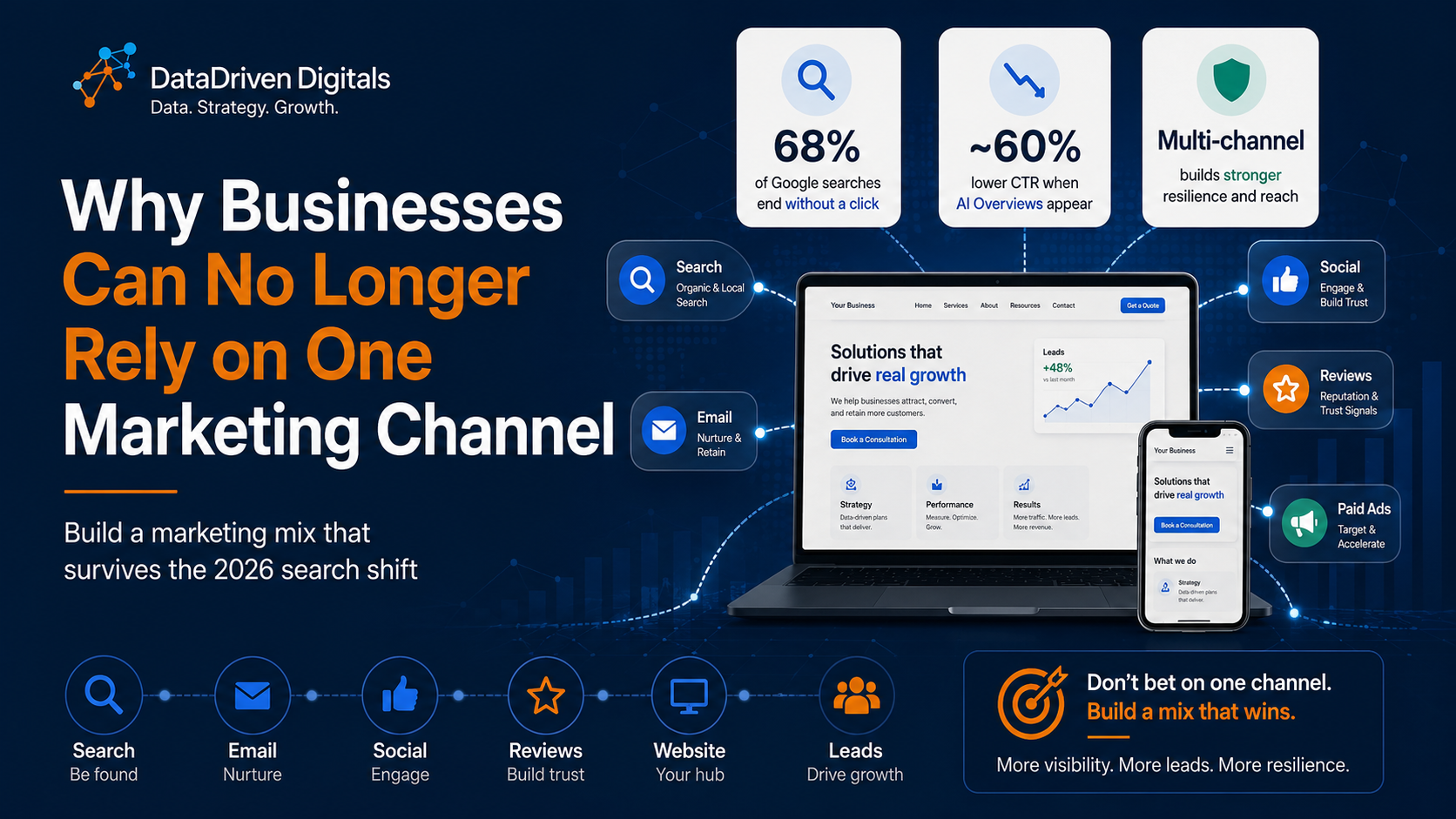
What the 2026 search shake-up means for small and mid-sized businesses — and how to build a marketing mix that survives it.
For years, many small businesses ran on a single engine. Maybe it was Google, where ranking on page one delivered a steady stream of clicks. Maybe it was Facebook ads, or referrals, or a single email list. It worked - until it didn’t.
In 2026, that single-engine model is breaking in front of everyone. In the first four months of the year, roughly 68% of Google searches ended without a single click to any website - up from about 50% in 2019. Google’s AI Overviews now answer questions directly at the top of the page, and when they appear, click-through rates fall by nearly 60%. The traffic many businesses quietly depended on is being absorbed into the search results themselves.
This isn’t only a search story. It’s the clearest signal yet of a wider truth: the channels you don’t control can change overnight, and when your whole business sits on one of them, you don’t get a vote. This article breaks down what’s actually changing in 2026, the real risks of single-channel dependence, the data behind diversification, and a practical roadmap for spreading your bets without spreading yourself thin.
What actually changed: search in 2026
Search used to be a simple trade. You published a helpful page, Google ranked it, and people clicked through to your site. That contract is being rewritten in three ways at once.
1. AI Overviews answer the question before the click.
Google’s AI-generated summaries now appear on a large share of searches and synthesize an answer at the top of the page. For informational queries - “how to,” “what is,” “best way to” - many users never scroll to the blue links. Searches that trigger an AI Overview now show zero-click rates as high as 83%.
2. Zero-click is the new normal.
Even outside AI Overviews, Google increasingly keeps users on its own surface with featured snippets, maps packs, and instant answers. SparkToro’s 2026 analysis found that fewer than one in three Google searches still sends a click to the open web. The search box has become a destination, not a doorway.
3. The damage is uneven — and that’s the trap.
Some sectors have lost 40–70% of their organic traffic in a single year, while transactional businesses (where people still have to visit a site to buy) have been hit less hard so far. The danger is that “less hard so far” lulls owners into thinking they’re safe. The direction of travel is clear, and it points the same way for everyone.
Here’s the uncomfortable part: none of this was a decision you made. A platform changed its product, and your traffic changed with it. That is the whole problem with depending on one channel, stated in a single example.
The five real risks of relying on one channel
Single-channel dependence rarely feels risky while it’s working. The risks are mostly invisible until the moment they aren’t. Here are the five that matter most for SMBs.
1. Platform and algorithm volatility
Every channel you don’t own can change the rules without warning - and frequently does. A search algorithm update, a feed change, a new AI feature, or a tweak to ad-bidding logic can cut your reach in half overnight. AI Overviews are just the latest, largest example. If one platform is your only path to customers, every update is a coin flip with your revenue.
2. Account suspensions and lockouts
Ad accounts get restricted. Business pages get flagged by automated systems. Email domains land on blocklists. When that channel is your only one, a suspension isn’t an inconvenience - it’s an outage of your entire pipeline, often with slow, impersonal support on the other end. Diversification is the difference between “a bad week” and “no leads at all.”
3. Rising and unpredictable costs
Paid channels follow a predictable arc: cheap and effective early, then steadily more expensive as competition piles in. If paid search or paid social is your sole source of customers, you have no leverage when costs climb - you simply pay more for the same result, because you have nowhere else to go. A mix of channels gives you somewhere to shift budget when one gets expensive.
4. A ceiling on reach
No single channel reaches everyone. Your best future customers are scattered across search, social platforms, inboxes, podcasts, communities, and word of mouth - and they don’t all live where you’ve planted your flag. Betting on one channel means writing off everyone who isn’t there. As one analysis put it, it cuts off relationships with whole communities that simply don’t share your channel.
5. Fragile attribution and decision-making
When everything comes from one source, you can’t actually tell what’s working - you only see the last click. You miss the social post that started the journey, the review that built trust, and the email that closed it. That blind spot leads to bad budget decisions and makes you even more dependent on the one channel you can measure.
The modern buyer doesn’t move in a straight line. They might see a social post, search your brand, read reviews, click a retargeting ad, open an email — and only then buy. Show up on one channel and you only see one frame of a much longer film.
The data is one-sided: more channels win
If single-channel marketing is the risk, multi-channel marketing is the well-documented payoff. The numbers consistently point in the same direction.
The takeaway isn’t “be everywhere.” It’s that customers already move across channels on their own, and businesses that meet them in more than one place capture more of the journey — and far more of the value.
What “not relying on one channel” really means
Diversifying isn’t about cloning the same post onto ten platforms. It’s about building a connected mix where channels do different jobs and reinforce one another. Three principles make it work.
Balance channels you rent with channels you own.
Search rankings, social feeds, and ad accounts are rented - the landlord sets the rules. An email list, an SMS list, a customer database, and your own website are owned: nobody can suspend your relationship with people who already chose to hear from you. A strong search foundation and conversion-ready service pages make that owned hub something people actually find and act on. The 2026 search shift is a loud reminder to move more of your audience onto channels you control.
Let each channel play a role.
Channels aren’t interchangeable. A healthy mix usually spans three jobs: discovery (how new people find you - search, social, referrals), nurture (how you build trust - email, content, retargeting), and conversion (where the sale happens - your site, a call, a store). Mapping your channels to these roles quickly reveals where you’re exposed.
Connect them so they compound.
The strongest mixes share data and a consistent message. A visitor from search joins your email list; an email subscriber sees a matching social ad; a social follower gets a relevant offer. Each channel makes the others work harder - which is exactly what single-channel marketing can never do.
A practical roadmap for diversifying (without burning out)
For a small team, “diversify your channels” can sound like “do five times the work.” It doesn’t have to. Add channels deliberately, one at a time, starting from the one you already have.
- 1. Audit your dependence. Write down where your last 20–50 customers actually came from. If more than half trace to one channel, that’s your risk — name it honestly.
- 2. Protect what’s working. Don’t abandon your strongest channel. Keep investing in it while you build others, so you’re adding stability rather than gambling.
- 3. Capture an owned audience first. Before chasing a new platform, make sure you’re collecting emails or phone numbers from people who already find you. This is the cheapest, fastest hedge against any platform change.
- 4. Add one adjacent channel. Pick a second channel close to where your customers already are - if search drives you today, add email and one social platform rather than five at once.
- 5. Connect the dots. Make the channels talk: put your lead magnet on your site, retarget visitors, and send subscribers to your social profiles. Reuse one piece of content across formats instead of creating from scratch each time.
- 6. Measure and rebalance quarterly. Every quarter, review where customers came from and shift effort toward what’s working. Diversification is a habit, not a one-time project.
Start here this week: Add an email capture to your highest-traffic page. It turns borrowed attention from a rented channel into an audience you own - the single highest-leverage move against the 2026 search shift.
The bottom line
The businesses struggling most in 2026 aren’t the ones doing marketing badly. Many did one thing very well - and built everything on top of it. Then the ground moved. AI Overviews and zero-click search are this year’s reminder that any channel you don’t own can change without asking you.
You don’t need to be on every platform. You need to stop being on only one. Spread your reach across a few connected channels, move your best customers onto channels you control, and you trade fragility for resilience. In a year when the rules of search are being rewritten in real time, that resilience is the most valuable asset a small business can have.
Not sure where your business is overexposed? DataDriven Digitals helps independent service businesses build that resilient foundation. Request a Search Visibility Snapshot to see where customers find you now, where you may be missing visibility, and which fixes are worth making first.
Sources
- Google zero-click searches reach 68% in early 2026 — Search Engine Land
- In 2026, Less than One Third of Google Searches Still Send a Click — SparkToro
- Zero-Click Search Statistics 2026 — Digital Applied
- 25 Omnichannel Statistics (287% purchase rate; 89% retention) — Porch Group Media
- Omnichannel & multi-channel marketing statistics for 2026 — Revenue Memo
- Why One Marketing Channel Is Never Enough Anymore — Alta Vista
-->