|
Old SEO |
Authority Optimization |
|
|---|---|---|
|
Rank pages for keywords |
Get chosen as a source for answers |
|
|
Backlinks as the currency |
Brand mentions, citations, and reviews as the currency |
|
|
Traffic volume as the goal |
Visibility + conversion quality as the goal |
|
|
Content proves expertise and earns citations |
|
|
Win on your website |
Win across Reddit, YouTube, press, reviews, and AI answers |
|
|
Measured by rankings and sessions |
Measured by share of citations, branded demand, and pipeline |
SEO Is Becoming Authority Optimization: Why Being Trusted Now Beats Being Ranked
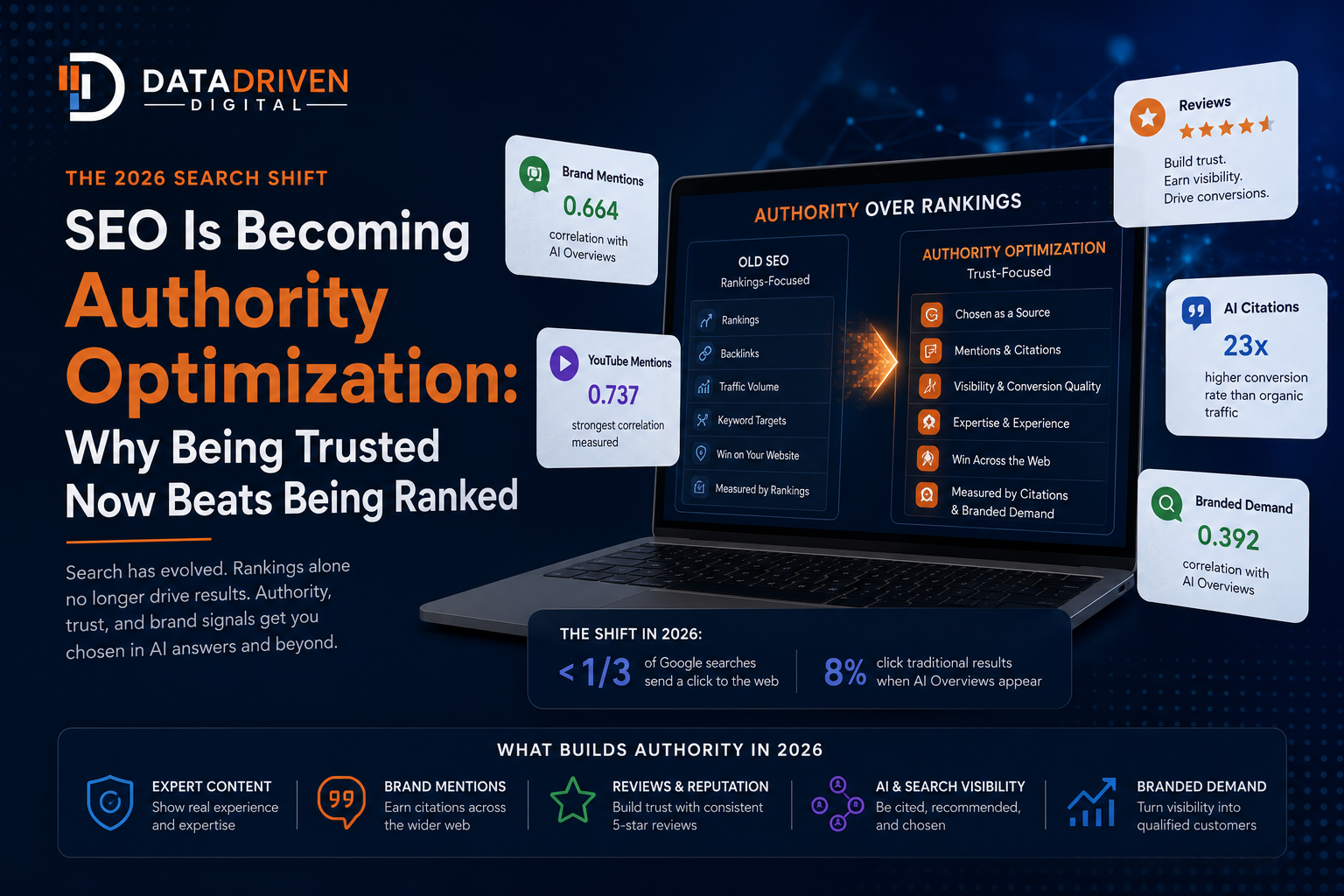
Traditional SEO promised a simple deal: rank on page one, get the click, win the customer.
That deal is collapsing. In early 2026, fewer than one-third of Google searches sent a click to the open web, according to SparkToro and Similarweb clickstream data. When an AI Overview appears, Pew Research Center found users click a traditional result in just 8% of searches — nearly half the rate of pages without one. And links inside the AI summary itself? Clicked just 1% of the time.
Search isn’t dying. It’s being re-routed through an answer layer — Google’s AI Overviews and AI Mode, ChatGPT, Perplexity, Gemini — that decides which brands get mentioned, cited, and recommended before a click ever happens.
That changes the job. You’re no longer optimizing pages to rank. You’re optimizing your business to be trusted — by algorithms, by AI models, and by the people reading their answers.
Welcome to authority optimization.
What Is Authority Optimization?
Authority optimization is the practice of building verifiable credibility signals — on your site, around your brand, and across the wider web — so that search engines and AI systems select you as a source and recommend you as an answer.
It absorbs classic SEO rather than replacing it. Crawlability, site structure, and useful content still matter. What changes is the target: instead of engineering rankings for keywords, you’re engineering recognition for your brand.
Here’s the shift at a glance:
Why the Shift Is Happening Now
Four forces converged:
- The answer layer went mainstream. 60% of Americans now read AI summaries in search results, per Pew’s 2026 follow-up research. Gartner predicted a 25% drop in traditional search volume by 2026 as chatbots absorb queries — and the click data above suggests the effective drop in clicks is even steeper.
- Google spent a decade preparing for this. From the Penguin crackdown on manipulative links, to E-E-A-T (Experience, Expertise, Authoritativeness, Trustworthiness) in its quality guidelines, to the helpful content system folded into its core algorithm — every major update has moved in the same direction: reward demonstrated credibility, punish synthetic authority.
- AI models infer reputation from the whole web. Large language models learn who you are from journalism, forums, reviews, video transcripts, and social discussion — not just your website. Semrush’s analysis of AI citations shows Reddit, YouTube, and trusted review platforms among the most-cited sources in AI answers. Those are surfaces you can’t control, only earn.
- Users changed too. Buyers arrive pre-researched and skeptical. They want evidence a business understands their problem before they ever make contact — and increasingly, an AI has already summarized the evidence for them.
The Data: Brand Signals Now Beat Backlinks
If you want one dataset that captures the whole shift, it’s Ahrefs’ study of 75,000 brands measuring what correlates with visibility in Google’s AI Overviews:
- YouTube mentions: 0.737 correlation — the strongest signal measured
- Branded web mentions: 0.664
- Branded anchor text: 0.527
- Brand search volume: 0.392
- Backlinks: 0.218 — outperformed 2–3x by off-site brand signals
Read that again: the metric SEO agencies sold for twenty years is now the weakest of the major predictors. What people say about you — on platforms you don’t own — predicts AI visibility better than links ever did.
Seer Interactive’s research points to the same direction: brands ranking on page one of Google showed a ~0.65 correlation with LLM mentions, and brand awareness measurably shapes whether models name you at all. Seer even coined a term for the failure mode — “ghost citations” — where your content is trusted enough to be sourced, but your brand isn’t known enough to be mentioned.
And here’s the payoff for getting it right: the traffic that survives the answer layer is better traffic. Ahrefs found AI search visitors made up just 0.5% of its site visits but drove 12.1% of signups — roughly a 23x conversion advantage over organic. Semrush’s clickstream analysis shows ChatGPT’s outbound referral traffic grew 206% year over year. Fewer clicks, but pre-qualified ones: the AI already did the comparing before the visitor arrived.
One caution against overcorrecting: Google still commands over 90% of global search usage. Users aren’t abandoning Google — they’re encountering AI inside it. Authority optimization wins on both surfaces; abandoning SEO fundamentals wins on neither.
The Three Layers of Authority
Authority isn’t one signal. It’s a stack. Weakness at any layer caps the others.
Layer 1: Prove It (Your Website)
Your site is the evidence file AI systems and skeptical buyers check.
- Publish depth on a narrow set of topics you have the right to own — disciplined topical focus beats scattered keyword-chasing
- Show real experience: named authors with credentials, original data, case studies, specifics no competitor could fake
- Keep the technical foundation solid: fast, crawlable, structured data, clear site architecture
- Make service pages explain the problem, approach, and proof — not read like every competitor’s list
Layer 2: Be Known (Your Brand Entity)
Search engines and LLMs treat you as an entity, not a URL. Strengthen the entity:
- Grow branded search demand — it’s a top predictor of AI citations
- Keep name, positioning, and descriptions consistent everywhere (site, LinkedIn, directories, profiles)
- Build visible authors and spokespeople; people get cited, faceless brands get paraphrased
- Claim and complete every profile that defines you: Google Business Profile, industry directories, review platforms
Layer 3: Be Everywhere (The Wider Web)
This is where authority is validated in public — and where AI models learn your reputation:
- YouTube — the single strongest AI-visibility signal in Ahrefs’ data
- Reddit, Quora, and communities — among the most-cited sources in AI answers
- Digital PR and journalism — earned mentions in trusted publications
- Reviews — G2, Trustpilot, Google reviews, industry-specific platforms
- Podcasts, events, partnerships — every appearance creates citable, crawlable evidence
- Audit your AI visibility. Ask ChatGPT, Perplexity, Gemini, and Google AI Mode the questions your customers ask. Note who gets named, who gets cited, and whether you appear at all.
- Pick 3–5 topics to own. Choose by commercial relevance and credibility, not raw search volume. Cut or consolidate content outside them.
- Build canonical explainers. For each topic, create the definitive guide — structured, clearly authored, regularly updated, written to be quoted. These become the raw material AI systems cite.
- Add proof density. Original stats, named clients, before/after numbers, credentialed authors. Every claim an AI could check, make checkable.
- Systematize reviews. A steady stream of third-party reviews is authority you can schedule.
- Start a YouTube presence. Even modest, consistent video builds the strongest correlated signal in the dataset.
- Earn mentions, not just links. Pitch data and expert commentary to industry press. An unlinked mention in a trusted publication now carries real weight.
- Show up in communities honestly. Answer questions in the subreddits and forums your buyers read. Value first; AI models are learning from these threads.
- Track authority, not just traffic. New scoreboard below.
The Authority Optimization Playbook: 9 Moves
The New Scoreboard
|
Old KPI |
Authority-Era KPI |
|---|---|
|
Keyword rankings |
Share of AI citations for your core topics |
|
Organic sessions |
Branded search volume trend |
|
Backlink count |
Brand mention velocity (linked + unlinked) |
|
Bounce Rate |
Conversion rate of AI-referred visitors |
|
Traffic growth |
Enquiry quality and pipeline from organic + AI |
Traffic will look worse before results look better — that’s the zero-click math, not a failing strategy. Judge the system on demand and pipeline, not sessions.
What to Stop Doing
- Publishing thin posts because a tool found search volume
- Buying links or chasing raw backlink counts
- Treating SEO as a bolt-on channel separate from PR, reviews, and brand
- Reporting success in sessions while inquiries stay flat
- Waiting for “AI search best practices” to settle — the brands being cited today are training the models’ picture of the category
The Bottom Line
SEO isn’t dead. It’s graduating - from a traffic tactic into an authority system that spans your website, your brand, and every platform where your reputation lives.
The uncomfortable part: authority is slower to build and impossible to fake. The good part: it compounds, it survives algorithm updates, and it’s the one asset that works across Google, ChatGPT, and whatever comes next.
The businesses that win the next five years of search won’t be the ones that ranked best. They’ll be the ones the machines - and the people - learned to trust.
Want to know how visible your business actually is across Google and AI search? We can audit your search and AI visibility and build your authority roadmap. Get in touch.