|
What the data shows |
Why it matters to you |
|---|---|
|
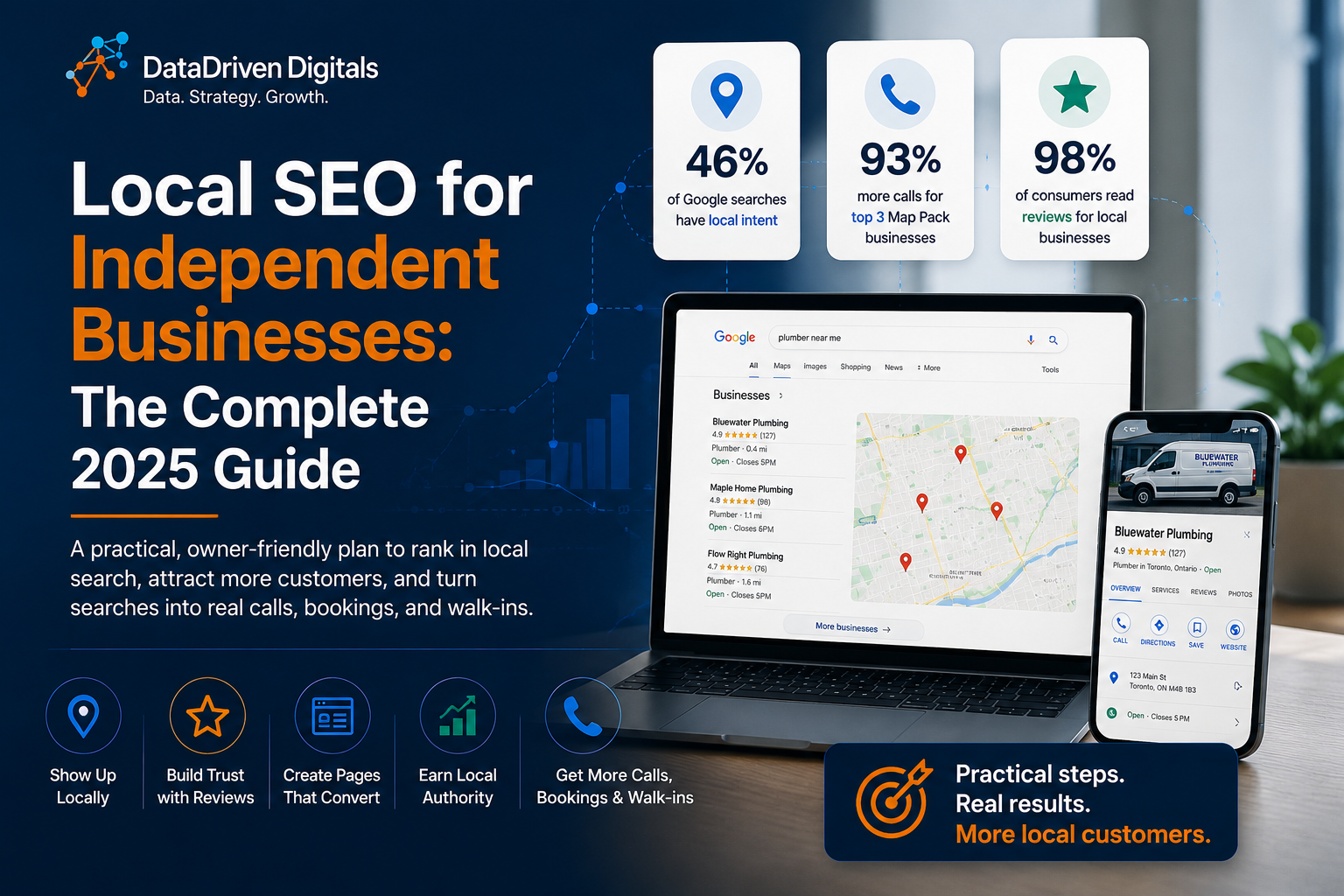
~46% of all Google searches have local intent (BrightLocal) |
Nearly half of searchers want a nearby business — like yours |
|
The top 3 Map Pack results capture the large majority of clicks and calls |
Being in the pack vs. just below it is the difference that matters |
|
97% of consumers read reviews for local businesses, and 41% "always" do (BrightLocal LCRS 2026) |
Your reviews are the sales pitch you don't write |
|
Reviews now influence ~16% of Local Pack rankings (BrightLocal Ranking Factors) |
A steady review habit pays off in visibility, not just trust |
Local SEO for Independent Service Businesses: The Complete 2026 Guide
You run the business, do the work, and answer the phone. Marketing gets whatever time is left over — which usually isn't much. The good news: winning local customers comes down to a handful of clear, repeatable moves. The hard part isn't knowing what they are; it's doing them consistently while you're also running the business.
This guide lays out exactly what good looks like for independent service businesses — trades, home services, clinics, salons, studios, consultants, and the like — so you can judge your own setup, run the playbook yourself, or know what to expect from a partner who does it for you. "Getting found" in 2026 means showing up in three places at once: the Google Map Pack, the regular organic results, and the AI answers (Google's AI Overviews, AI Mode, ChatGPT, Perplexity) that increasingly sit on top of both.
Do these 5 things this week
If you read nothing else, start here. Each takes under 30 minutes and moves the needle.
- Fix your Google Business Profile category and hours. Set the most accurate primary category, add holiday hours, and confirm your service area.
- Upload 5 fresh photos of your team, your work, and your finished results — real photos, not stock.
- Send 3 review requests by text and email to customers from this week's jobs, with your direct Google review link.
- Make your name, address, and phone (NAP) identical everywhere — website, Google, Bing, Apple, the major directories.
- Publish or upgrade one service page that answers what the job costs, what's included, and what happens when they book.
What changed in local search (and what didn't)
Strip away the buzzwords and local SEO in 2026 is still about doing the basics well and doing them consistently. Google still matches nearby searchers to relevant, trusted businesses using three core ideas: relevance, distance, and prominence.
What changed is where you show up and how trust is judged:
- AI answers now sit on top of search. Google's AI Overviews now appear on close to half of all queries — and growing fast (up 58% year-over-year, per BrightEdge research). In some service-relevant categories it's far higher: restaurant queries jumped from 10% to 78% in a year. People read that summary before they click anything.
- "Prominence" now rewards real engagement, not just age and links. A newer business with an active, well-reviewed Google profile can outrank an older competitor that's coasting. Real-world signals — recent reviews, profile activity, calls, direction requests — carry more weight than they used to.
- Your Google Business Profile is now an AI input, not just a listing. AI local answers pull directly from your profile's categories, services, hours, reviews, and Q&A. For local AI search, your profile functions like a second website.
- The fundamentals still feed the AI — but AI cites differently. There's no separate "AI SEO" trick: the same signals that rank you also make you quotable. But don't assume a #1 ranking guarantees a citation — BrightEdge found only about 17% of AI Overview sources also sit in the organic top 10. The AI draws from the broader indexed pool and favors clear, well-structured, trustworthy answers. So rank well and write to be quoted.
The takeaway for an owner: you don't chase the AI separately. You make every signal — profile, reviews, pages, citations — clear, accurate, and recent, and you become the answer in all three places at once.
Why it's worth the effort
Local search isn't a vanity project; it's where service customers actually are.
How Google ranks you: the signals that decide it
BrightLocal's Local Search Ranking Factors study breaks ranking influence into these buckets. Spend your time in proportion to the weight.
|
Signal Group |
Approx. Weight |
What it covers |
|---|---|---|
|
Google Business Profile |
~32% |
Categories, completeness, posts, photos, activity |
|
On-page content |
~19% |
Service & location pages, titles, structure, schema |
|
Reviews |
~16% |
Recency, velocity, rating, detailed text |
|
Links |
~15% |
Local, relevant sites linking to you |
|
Behavioral |
~8% |
Clicks, calls, direction requests, time on profile |
|
Citations |
~7% |
Consistent NAP across directories |
The headline: your Google Business Profile is roughly a third of the battle, and reviews plus on-page content are most of the rest. That's where this plan focuses.
When you strip away the buzzwords, local SEO in 2025 is mostly about doing the basics really well—and doing them consistently. Google still wants to match nearby searchers with trustworthy businesses. What’s new is how those trust signals are surfaced: richer profiles, more review details, and AI summaries that reward clear answers. Think of it as housekeeping with helpfulness.
- Map Pack fundamentals: Proximity, relevance, and prominence still drive visibility. Your job is to make every signal (GBP, reviews, content, links) crystal clear and consistent.
- AI Overviews (AEO): Helpful, well-structured content with concise definitions, steps, and FAQs gets cited and summarized more often. Lead with the answer.
- Local Services Ads (LSA) vs SEO: LSA can capture ready-to-buy leads, but organic + GBP compound over time and reduce dependency on pay-per-lead. Use both where it makes sense.
- Zero-click behavior: Ratings, hours, photos, and page titles influence decisions before anyone clicks. Treat your search results as a storefront.
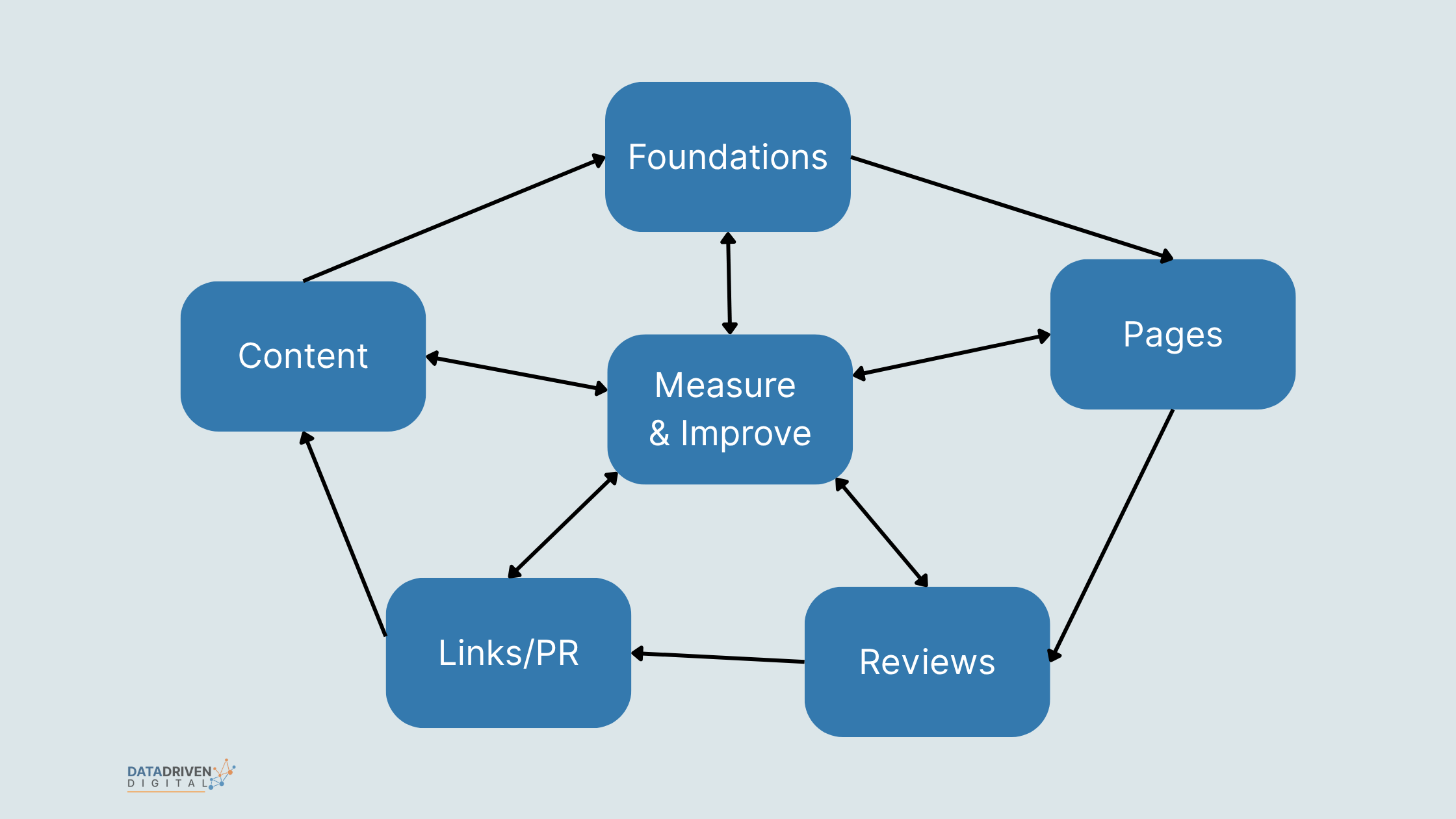
The 5-Stage Plan (first 90 days)
Stage 1 — Foundations (Weeks 1–2)
Audit and prioritize
- Create one "NAP master record": your exact business name, address, phone, and hours, written once and copied everywhere.
- Check how you rank for your brand name plus 10 non-brand service terms (e.g., "furnace repair [city]").
- Confirm Google Analytics (GA4) and Google Search Console are installed and verified.
- Pick the 10 highest-impact fixes for the next 90 days and ignore the rest for now.
Google Business Profile setup / refresh (your single biggest lever)
- Choose the most accurate primary category; add 2–3 relevant secondary categories. Don't over-stuff — accuracy beats quantity.
- Complete the description, full service/product list, attributes (accessibility, payment types, languages), and service-area settings.
- Add a logo, cover photo, and real team/process/result photos. Profiles with 30+ photos earn meaningfully more clicks and direction requests than near-empty ones.
- Post at least twice a week. Posting frequency is now a top-tier signal — share offers, "what to expect," and FAQs.
- Turn on messaging only if you can reply fast. Seed the Q&A section with the real questions customers ask.
NAP consistency and core citations
- Claim and clean Google, Apple Business Connect, Bing Places, and Yelp first.
- Add the directories that matter for your trade — Healthgrades/Vitals for dental and medical; Angi, Thumbtack, HomeStars, or Nextdoor for home services and trades.
- Remove duplicate listings and make every entry match your master record exactly. This matters more than ever: NAP inconsistencies across multiple sources can quietly get you excluded from AI local answers a majority of the time.
- Keep a living spreadsheet of every listing and recheck it quarterly.
Stage 2 — Pages that convert (Weeks 2–4)
Service pages — one per service
Each should cover: who it's for, the problem it solves, your process step by step, pricing guidance ("starting at" or a range), FAQs, proof (reviews and photos), and a strong Call / Book button. Use the URL pattern /services/<service> and link it from your homepage and related services.
Location / service-area pages — one per city you actually serve
No copy-paste boilerplate. Each page needs a unique intro, real proof or projects in that city, a neighborhood list, directions, an embedded map, and a CTA tailored to that area. Use /locations/<city>. One thin page covering five cities will not rank for any of them.
On-page essentials
- A clear title and H1, with scannable H2s written as the questions customers actually ask.
- Schema markup:
LocalBusiness,FAQ, andService(andPostalAddress). This is doubly important now — structured data is exactly what AI engines read to decide your geographic relevance and whether to cite you. - Compressed images with descriptive alt text, and a tap-to-call phone number on mobile.
Stage 3 — Reputation and proof engine (Weeks 4–6, then forever)
Reviews are about 16% of your ranking and close to 100% of your sales pitch — 97% of people read them before choosing, and 41% say they always do.
Reviews program
- Ask right after the job closes, when satisfaction is highest. Request by SMS and email with your direct Google review link.
- Velocity beats volume. A steady 4–8 substantive reviews a month outperforms a one-time burst followed by silence.
- Coach customers to mention specifics — the service, the speed, the cleanliness, and the city. Detailed reviews help both rankings and AI answers.
- Reply to 100% of reviews within 48 hours, good or bad. Keep it short, human, and helpful.
Before/after and mini-cases
- Capture 3 photo sets a month with 80–120 word captions describing the work.
- Post them to your profile and the relevant service/location page; reuse on social and your newsletter.
- Tag each by service and by city to build local relevance.
Stage 4 — Local links and community signals (Weeks 6–10)
- Easy wins: chamber of commerce, trade associations, supplier and partner "find a provider" pages.
- Community: sponsor a youth team or local event, then write a short story with photos on your site.
- Local PR: pitch small, useful stories quarterly — a new service, a seasonal checklist, a donation drive — with a local stat, a quote, and a photo to make coverage easy.
Stage 5 — Content that pulls customers in and earns AI citations (Week 8+)
You don't need a newsroom. Publish one genuinely useful local piece a month that answers a question people ask before they book. This is also your best play for getting named in AI answers.
What to publish:
- "How to choose" guides — "How to Choose a Furnace Repair Company in [City]: 5 Questions to Ask First."
- Transparent pricing explainers — "What Does a Dental Cleaning Cost in [City]? What Affects the Price."
- "What to expect" walk-throughs — "Your First Visit: Timeline, Comfort, and Results."
- Seasonal checklists for your region — "Pre-Winter Furnace Tune-Up Checklist for [Region] Homes."
How to write it fast (and get it quoted by AI):
- Lead with the answer in the first 2–3 lines. Answer engines extract the clearest, earliest direct answer.
- Add a numbered list of 4–6 steps or tips.
- Include one real local detail — a neighborhood, a local by-law, a typical local scenario.
- Close with a clear next step: Call, Get a quote, or Book online.
Where to share: publish on your site, cross-post a summary as a Google Business Profile post, and share the top tip on social.
Winning AI search: a closer look at AEO and GEO
This is the part most "small business" guides skip. Two terms worth knowing:
- AEO (Answer Engine Optimization): structuring content so AI search features — Google's AI Overviews and AI Mode, voice answers, featured snippets — can pull a clean, direct answer from you.
- GEO (Generative Engine Optimization): getting named and cited inside answers from generative tools like ChatGPT, Claude, and Perplexity.
Here's the reassuring part: for an independent service business, AEO and GEO are mostly the local SEO you're already doing — done cleanly. Local pages give answer engines precise, structured facts (what you do, where, what it costs, why you're relevant), which makes them strong citation candidates.
To tilt the odds in your favor:
- Answer the question in the first sentence on every page and post.
- Use schema markup so machines can read your business as an entity, not just text.
- Keep your Google Business Profile clean and active — it's the primary input for local AI answers.
- Build real, detailed reviews. Volume and substance of reviews appear to influence whether AI surfaces you; some 2026 analyses point to well-reviewed profiles (roughly 150+ reviews per location in competitive categories) being far likelier to get cited. You don't need that overnight — steady velocity gets you there.
- Keep your NAP identical everywhere. Inconsistency is one of the fastest ways to get filtered out of AI local results.
You are not optimizing for the AI separately. You're making yourself the clearest, most consistent, best-reviewed answer — and the AI quotes the clearest answer.
Measurement: track what pays the bills
Watch the actions that produce revenue, not just traffic.
- KPIs: calls, form fills, direction requests, and bookings — plus Google Business Profile insights, non-brand clicks in Search Console, and page-level conversions.
- Rank tracking: follow 10 core terms across 2–3 neighborhoods with a simple geo-grid.
- Attribution: dynamic call tracking on your website only (never change the NAP on your profile), UTM tags on your profile posts, tagged links in email.
- Quarterly review: Keep / Change / Start / Stop — then queue the next experiments.
Myths to ignore in 2026
- "More citations always win." Accuracy and consistency beat long lists of weak directories.
- "Stuff the city name into every heading." Write for people; add the city where it's genuinely useful.
- "One locations page covers all my cities." It covers none of them. One real page per city.
- "Reviews don't affect rankings." They drive prominence, clicks, trust — and now AI citations.
- "AI killed SEO, so why bother." The opposite: ranking well is how you get into the AI answer.
Owner’s Checklist
Print it, share it with your team, review it monthly.
- Google Business Profile verified, complete, and posting 2x/week
- Exact-match NAP master record + core citations claimed and consistent
- One page per service + one real page per target city
- Schema in place (LocalBusiness, FAQ, Service)
- 4–8 substantive reviews/month + 100% response rate within 48 hours
- Two new local links/partnerships per quarter
- One helpful local article per month, answer-first for AI
- Tracking calls and bookings + quarterly rank and conversion review
FAQs
How long until I see results?
Foundations can show movement in 2–4 weeks. Pages, reviews, and links compound over 2–3 months. Profile actions (calls, direction requests) usually rise before rankings fully catch up.
How many reviews do I need, and how fast?
Aim for a steady 4–8 a month with real detail. Recency and substance matter more than hitting a magic number, and steady velocity beats a one-time burst.
Do I need separate pages for nearby cities?
Yes — if you want to rank and win customers there. One helpful page per city with genuine local proof.
Should I pay for LSA if I’m doing SEO?
If the return is healthy, LSAs can fill the pipeline while your organic presence compounds. Track cost per booked job and avoid depending entirely on pay-per-lead.
How do I get my business into AI Overviews and ChatGPT answers?
There's no separate trick. Rank well organically, keep your Google profile clean and active, use schema, write answer-first content, and build detailed reviews. AI engines cite the clearest, most consistent, best-reviewed source.
What if a competitor is spammy (name stuffing, fake addresses)?
Suggest an edit or file a redressal request with evidence, and keep building your own legitimate signals — reviews, photos, content, and links win over time.
Is blogging still worth it with AI Overviews?
Yes — especially short, specific, local answers with steps and FAQs. That format is exactly what gets read by customers and quoted by AI.
This guide is for independent, owner-operated service businesses. Start with the five quick wins, work the 90-day plan in order, and review your numbers every quarter.