|
What to record |
Example |
|---|---|
|
Inquiry date and source |
Website form, phone, or ad |
|
Service requested |
The service the customer asked about |
|
Inquiry status |
Reached, qualified, or not a fit |
|
Outcome |
Booked, declined, or still deciding |
|
Follow-up needed |
Who will respond and when |
Growth Marketing for Independent Service Businesses: A Practical Playbook
You run the business, serve customers, answer calls, and handle the details. Marketing has to fit around that work.
Adding channels without a clear path to booking can spread your time and budget. Start with one service, one offer, and one way to measure whether people take the next step.
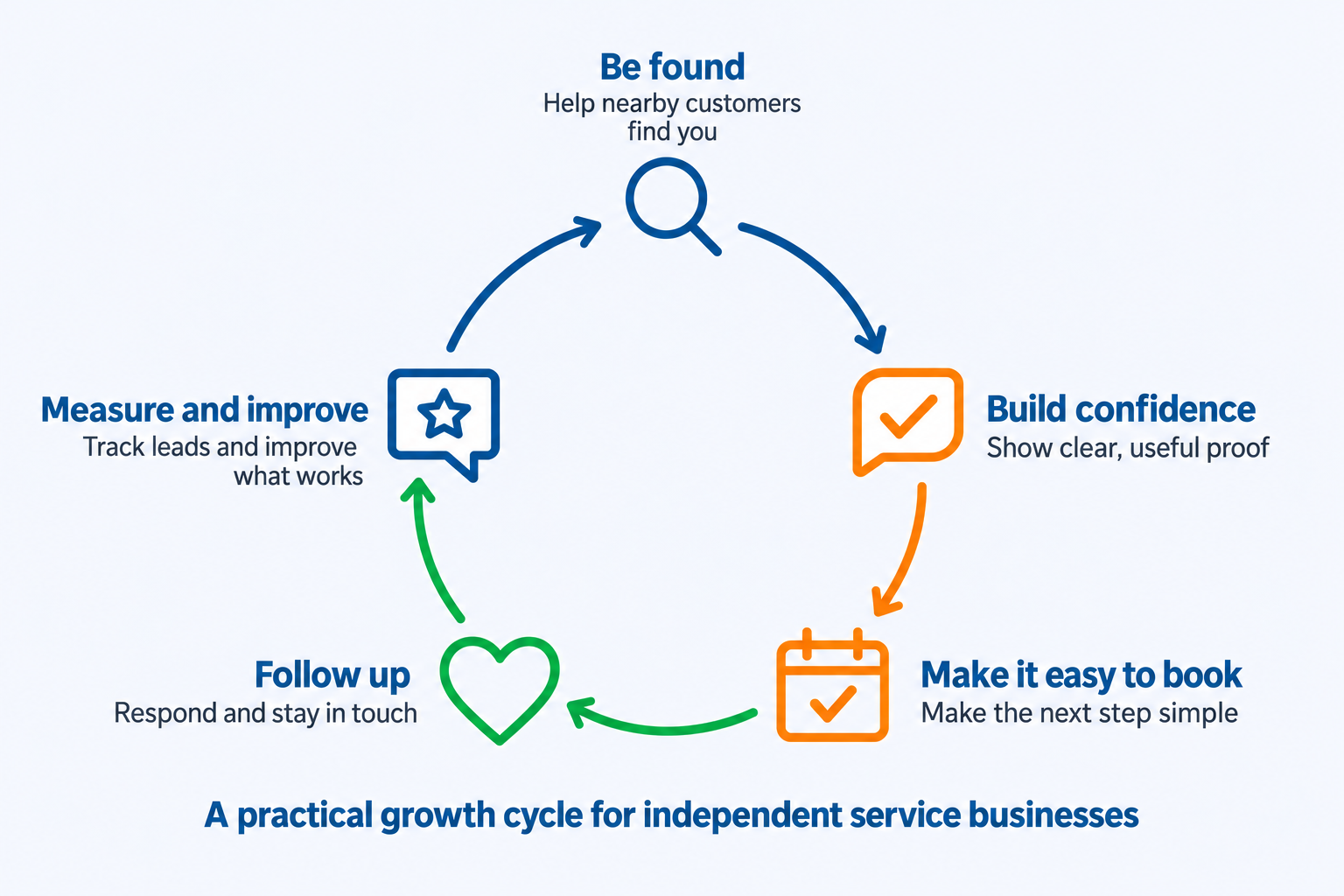
This playbook connects five parts of that path: be found, build confidence, make it easy to book, follow up, and measure what happens. It is a 90-day work plan, not a promise of results in 90 days.
Start with one service and one goal
Pick a service you want to grow. Then answer these questions:
- Who is most likely to book it?
- Where do those customers live or work?
- What do you want them to do: call, book, or request a quote?
- Do you have the time and capacity to take on more work?
Choose one main action to track. For a clinic, that could be a new-patient appointment. For a home-service business, it could be a qualified estimate request.
Keep your offer clear. It could be a named service, a starting price, or a short explanation of what a first visit includes. A discount is optional. Check your costs before you offer one.
Make it easy to choose your business
A potential customer should be able to understand your service and decide what to do next.
A useful service page answers:
- Who is the service for?
- What does it include?
- What happens after the customer books?
- What affects the price?
- What proof can you share, such as credentials, reviews, or real project photos?
- How can the customer call, book, or request a quote?
Use one clear next step on the page. Keep the phone number or booking button easy to find on a mobile screen.
A location page serves a different purpose from a service page. The right structure depends on how your business operates and what customers need to know. See our guide to service pages and location pages.
Help the right customers find you
Local SEO is the work that helps your business appear in search results for people looking for services in or near the areas you serve.
Start with accurate business information on your website and Google Business Profile. Google says local results mainly reflect relevance, distance, and prominence. Reviews and links can contribute to prominence, although no single update guarantees a ranking.
Your website should explain your services in clear terms and give visitors a direct next step. Google’s guidance on helpful, reliable content is a useful standard: write pages to answer real customer questions, and support your claims with accurate details.
Google’s AI search features use the same foundational SEO practices. There is no special page format or schema that guarantees a mention. For more detail, see Google’s AI-feature guidance and our article on trust signals for Google and AI systems.
For a broader local SEO plan, see our local SEO guide for independent service businesses.
Use paid search when it fits the goal
Paid search can help a business reach people who are looking for a service now. It still needs a clear offer, a useful landing page, and a way to measure what happens after the click.
If you test ads:
- Start with one service and the area you can serve.
- Make sure the ad and landing page describe the same offer.
- Review the actual searches that triggered your ads.
- Pause searches that bring the wrong people or services.
- Track qualified inquiries and bookings, not clicks alone.
Google Ads supports different keyword matching options, and its search terms report shows the searches that triggered ads. Use that information to refine the campaign. A paid campaign can bring visits while it runs; it does not guarantee bookings.
Make follow-up simple
A customer may call while you are with another client or send a form after hours. Decide who checks new inquiries and how soon they should receive a response.
A basic follow-up process can include:
- A confirmation that the request arrived
- A clear description of the next step
- Useful details about the service or appointment
- A reminder when the customer has booked
- A later check-in, when it fits the service and the customer’s preferences
Keep messages relevant. Honor the contact choices customers made and the consent rules that apply where you operate.
Reviews can help future customers assess your business. After a genuine service experience, invite customers to share honest feedback in their own words. Do not offer rewards for reviews or tell customers what to write. See Google’s review guidance.
Track inquiries through booking
A website click or call-button tap does not tell you whether the business spoke with a qualified customer or booked the work. Track the next steps too.
A simple tracking sheet can record:
Use Google Search Console to review how your pages appear in Google Search, including the queries and pages that earn impressions and clicks. In Google Analytics 4, a key event can mark an action that matters to the business, such as a form submission. See Google’s guide to measuring key events.
Compare those reports with your inquiry and booking records. That helps you see where a customer path may be breaking down: few relevant visits, unclear service information, missed calls, or inquiries that do not become bookings.
A practical 90-day work plan
|
Timing |
Work to complete |
|---|---|
|
Weeks 1–2: Set the focus |
Choose one service and one customer action. Check the current page, Google Business Profile, contact options, and tracking. Record a starting point for inquiries and bookings. |
|
Weeks 3–6: Fix the path |
Improve the service page and booking steps. Confirm that calls and forms reach the right person. If paid search fits the goal and budget, test one focused campaign. |
|
Weeks 7–12: Review and adjust |
Check which searches, pages, and sources brought relevant inquiries. Compare inquiries with bookings. Keep the changes that support good-fit work, and choose the next issue to address. |
The schedule gives you a way to organize the work. Search visibility and bookings can change at different rates, and results depend on the business, market, and starting point.
Common problems to avoid
- Adding channels before fixing the offer. Make the service and next step clear first.
- Offering discounts without checking the costs. A promotion should still make sense for the business.
- Counting every call or form as a good lead. Record whether the inquiry fits the service and became a booking.
- Creating pages for every service and city. Add a page when it answers a real customer need and has useful information.
- Asking for reviews with suggested wording. Invite honest feedback and let customers choose what to say.
Frequently asked questions
Do I need to use several marketing channels?
No. Start with the channel that can reach the customers you want and that you can manage well. Add another when you can measure its role.
Should I use SEO or paid search?
It depends on the service, market, budget, and how quickly you need to test demand. SEO work improves the pages and business information customers use to evaluate you. Paid search buys ad placement while the campaign runs. Track the inquiries and bookings each source brings.
How soon will I see results?
There is no timeline that applies to every business. You can start tracking customer actions as soon as measurement is set up. Search visibility and booking patterns depend on your starting point, competition, and the work completed.
What should I measure first?
Track qualified inquiries and completed bookings for your priority service. Add search impressions, clicks, and ad costs to understand how customers found you.
Choose your next step
If you want an outside view of how your business appears in search and what to address first, start with the the Search Visibility Snapshot. You can also review our SEO services.