|
What's happening |
The number |
Source |
|---|---|---|
|
Google searches showing an AI Overview |
43%, up from 15% a year earlier | |
|
Google searches ending with zero clicks |
68.0%, up from 60.5% in 2024 | |
|
Click-through rate when an AI summary appears |
8%, vs. 15% with no summary | |
|
People who click the AI summary's own links |
1% of visits | |
|
Organic CTR drop on queries with an AI Overview |
61% (paid CTR: 68%) |
Why Experience-Led Content Is Surviving the Shift to AI Search
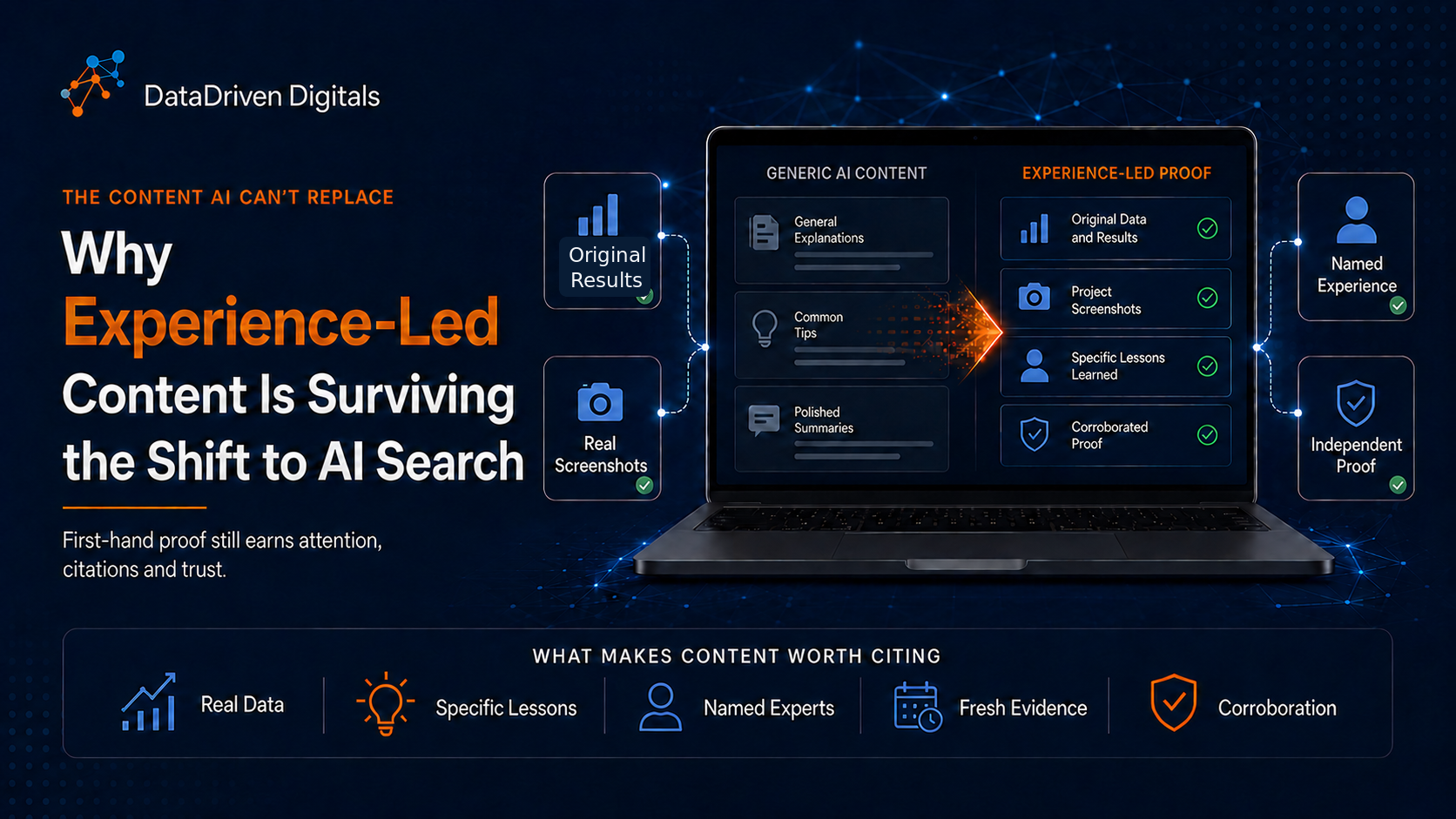
AI Overviews now show up on 43% of Google searches, up from 15% a year ago. 68% of all Google searches end without a click. By most measures, organic content is losing.
But not all of it. A specific kind of content keeps getting cited, clicked, and read even as the rest of the web gets summarized and skipped: content built on real, first-hand experience that AI can reference but can't actually replace. Here's what the current data shows about that split, and how to build the kind of content that ends up on the winning side of it.
The clicks really are disappearing
Start with the scale of the shift, because it's bigger than most 2025 predictions expected.
Pew's study is worth sitting with for a second, because of how it was built: 900 US adults, real browsing data, 68,879 actual Google searches tracked in March 2025. It's not a survey asking people what they think they do. It's what they actually did. And what they did, when an AI summary appeared, was leave. 26% of those visits ended the browsing session on the spot, compared to 16% when no summary showed up.
So the premise holds: AI search is genuinely cutting into clicks. It isn't only changing where those clicks land.
What's still getting through
Here's the part most "AI is killing SEO" takes skip: being summarized by AI and being cited by AI aren't the same fate, and citation still tracks closely with the sites that were already earning trust the old-fashioned way.
Ahrefs analyzed 1.9 million citations pulled from 1 million AI Overviews and found that 76.1% of cited pages already rank in Google's top 10. The median ranking position for a top-cited source is 3. Getting picked by the AI isn't a random draw from the whole internet, it's still mostly happening within the pool of pages that already prove themselves in traditional search.
And getting cited pays. Seer Interactive's data shows brands that get cited inside an AI Overview see 35% more organic clicks and 91% more paid clicks than brands that don't, even on the exact same query.
So two things are true at once: overall clicks are down across the board, and specific content is doing better than ever relative to everything else on the page. The question is what separates the two.
Why "experience" is the signal AI can't fake
Google added a second E to E-A-T back in December 2022: Experience. Not expertise. Experience. The distinction is the whole story.
Expertise can be synthesized. A language model can produce a technically correct explanation of how a heat pump works, how to file a trademark, or what causes plantar fasciitis, because that information exists thousands of times over in its training data. What it can't produce is a photo of the actual install, a screenshot of the actual result, or a description of the specific thing that went wrong on the third attempt that nobody writes about in the textbook version.
That's the gap experience-led content sits in. Google's Search Quality Rater Guidelines, last refreshed in September 2025, still spell this out directly: content should reflect that the creator has actually done, used, or lived through the thing they're writing about. AI systems built on top of Google's index are trained to approximate that same judgment. A hallucinated citation is a liability for the AI provider, not only an accuracy problem for the reader.
Practically, experience shows up as:
- Original results, not restated ones. Your own test data, your own before-and-afters, your own numbers from a real project, not a summary of someone else's study.
- A named person with a track record. A byline with real credentials attached, not "Admin" or a generic team account.
- Specific, sometimes unflattering detail. What didn't work. What took longer than expected. What surprised you. AI-generated content tends to smooth these edges out, which is exactly why their absence is now a tell.
- Evidence that can't be regenerated by a prompt. Photos, screenshots, timestamps, receipts, a described process with a beginning and an end.
The proof is showing up in an unexpected place: Reddit
Here's the finding that should reframe how most brands think about this. If experience is what AI systems are hunting for, you'd expect polished, credentialed brand content to win by default. It doesn't.
Otterly.ai's analysis of more than 1 million AI citations, published in February 2026, found that community platforms, led by Reddit as the single most-cited domain on the list, accounted for 52.5% of citations across ChatGPT, Perplexity, and Google AI Overviews, versus 47.5% for brand domains.
Reddit threads have no schema markup, no author bio, no domain authority in the traditional sense. What they have is thousands of people describing what actually happened to them, in their own words, argued over and corrected by other people who were also there. That's experience signal in its rawest form, which is why AI systems leaned on it so heavily.
Then, in mid-August 2026, Reddit's citation share inside ChatGPT specifically fell off a cliff. Tracking firm Promptwatch logged Reddit's daily share of ChatGPT Search citations dropping from roughly 3.8% to about 0.5% between August 7 and 14, an 86% relative decline in about a week. Search Engine Journal traced the timing to a jump in ChatGPT's use of site-specific searches around August 8, though the exact cause is still unconfirmed, and OpenAI has said it doesn't target a fixed visibility level for any one domain. Google's AI Overviews and AI Mode moved far less over that same stretch. That gap between platforms is the tell: this reads like a ChatGPT-specific engineering change, not a verdict on Reddit's content quality.
That's the real lesson, and it goes further than "go post on Reddit" ever did. Citation share on any single platform can evaporate in a week because of a change nobody outside that company saw coming. A strategy built on gaming one platform's current citation habits is built on sand. Content that's genuinely first-hand and verifiable holds up regardless of which platform, or which version of that platform's ranking logic, happens to be doing the citing this month.
Getting cited isn't the same as being trusted
Citation also isn't a clean stand-in for quality. Peec AI's analysis of 232,000 AI citations found that roughly 1 in 10 citations on Google AI Mode and Perplexity, and about 3.6% on ChatGPT, come from brands ranking their own product as the top pick in a listicle they published themselves. AI systems haven't fully solved for filtering out that kind of self-interest yet.
But getting cited that way doesn't pay off the way it looks like it should. Ahrefs ran a four-month experiment publishing 34 self-promotional pages and tracking nearly 10,000 AI responses. Their pages did get cited, but 43% of the answers that cited them never actually recommended them, and the citations themselves were unstable, appearing on only about one in three eligible days. Getting referenced got their page in front of the model. It didn't get the model to believe it.
That gap between being cited and being believed is where experience-led content has an edge self-promotion doesn't. A page built on real results survives the kind of scrutiny a listicle written to flatter its own product can't.
What AI can fabricate, and what it can't
This is the practical filter to run every piece of content through before you publish it.
|
AI can generate this convincingly |
AI can't fabricate this |
|---|---|
|
A general explanation of how something works |
A photo or screenshot from your own actual project |
|
A list of pros and cons for a product category |
A number pulled from your own tracked results |
|
A "how to" outline based on common advice |
The specific mistake you made and what fixed it |
|
Generic industry statistics, paraphrased |
quote from a named person willing to be checked |
|
A polished, confident tone |
A track record other people independently confirm |
If your content only contains items from the left column, an AI system can produce a version of it in about four seconds, which means it has no reason to send anyone to read yours. Everything in the right column is what makes a page worth citing, and worth clicking through to read in full.
How to build experience-led content that actually holds up
- Put a real name and a real track record on it. Not a generic bio. Specific credentials, specific years of experience, a specific reason this person's take is worth trusting on this exact topic.
- Show your own work. Screenshots, test results, before-and-afters, a described process with dates. If you didn't actually do the thing, don't write it as if you did.
- Keep the rough edges in. What surprised you, what took three tries, what the "textbook" answer gets wrong in practice. This is the part AI-generated content almost always smooths away, which makes it the easiest way to stand out.
- Update it, don't just publish it once. Freshness is becoming its own trust signal. Re-verify your stats and results on a set schedule instead of leaving a 2024 number live in 2026.
- Let other sources corroborate you. A claim that only exists in your own marketing copy carries less weight than the same claim showing up independently in reviews, forums, or press. Consistency across those sources is now part of how AI systems judge trust.
- Still rank well in traditional search. Ahrefs' data is a reminder that experience signals amplify a page that's already earning its place, they don't replace the need to be relevant, well-structured, and genuinely useful in the first place.
- Don't build your strategy around one platform's citation habits. ChatGPT's Reddit citations can drop 86% in a week over a change no one outside OpenAI announced. Build content that holds up no matter which platform, or which version of it, shows up to read it.
The bottom line
AI search isn't neutral about what it summarizes and what it sends people to go read for themselves. Individual platforms will keep shuffling which specific sources they cite, sometimes overnight, as August's Reddit numbers show. But the throughline underneath that noise has held all year: AI is compressing generic, restateable information into a box at the top of the page, and it's still routing attention and trust toward sources that show real, verifiable, first-hand experience, whether that source is a credentialed expert or a stranger on Reddit who actually did the thing.
The content that survives this shift isn't the content optimized hardest for the old rules. It's the content an AI system literally cannot produce a convincing substitute for. That's a narrower bar than "well-written" or "SEO-friendly." It's a higher one, and it's the one worth building for.
Want a clear read on which of your content is experience-led and which is easily replaced by a summary? Data Driven Digitals audits search visibility and content strategy for businesses working through exactly this shift.
-->