|
Rank |
Factor |
Score |
|---|---|---|
|
1 |
Primary GBP category |
227 |
|
2 |
Proximity to the searcher |
225 |
|
3 |
Keyword match in business name |
223 |
|
4 |
Physical address in the city searched |
213 |
|
5 |
Business open at time of search |
189 |
|
6 |
High star rating (4-5 stars) |
181 |
|
9 |
Volume of native Google reviews |
170 |
|
11 |
Review recency |
164 |
|
16 |
Overall profile completeness |
147 |
A Complete Google Profile Can Still Be Invisible
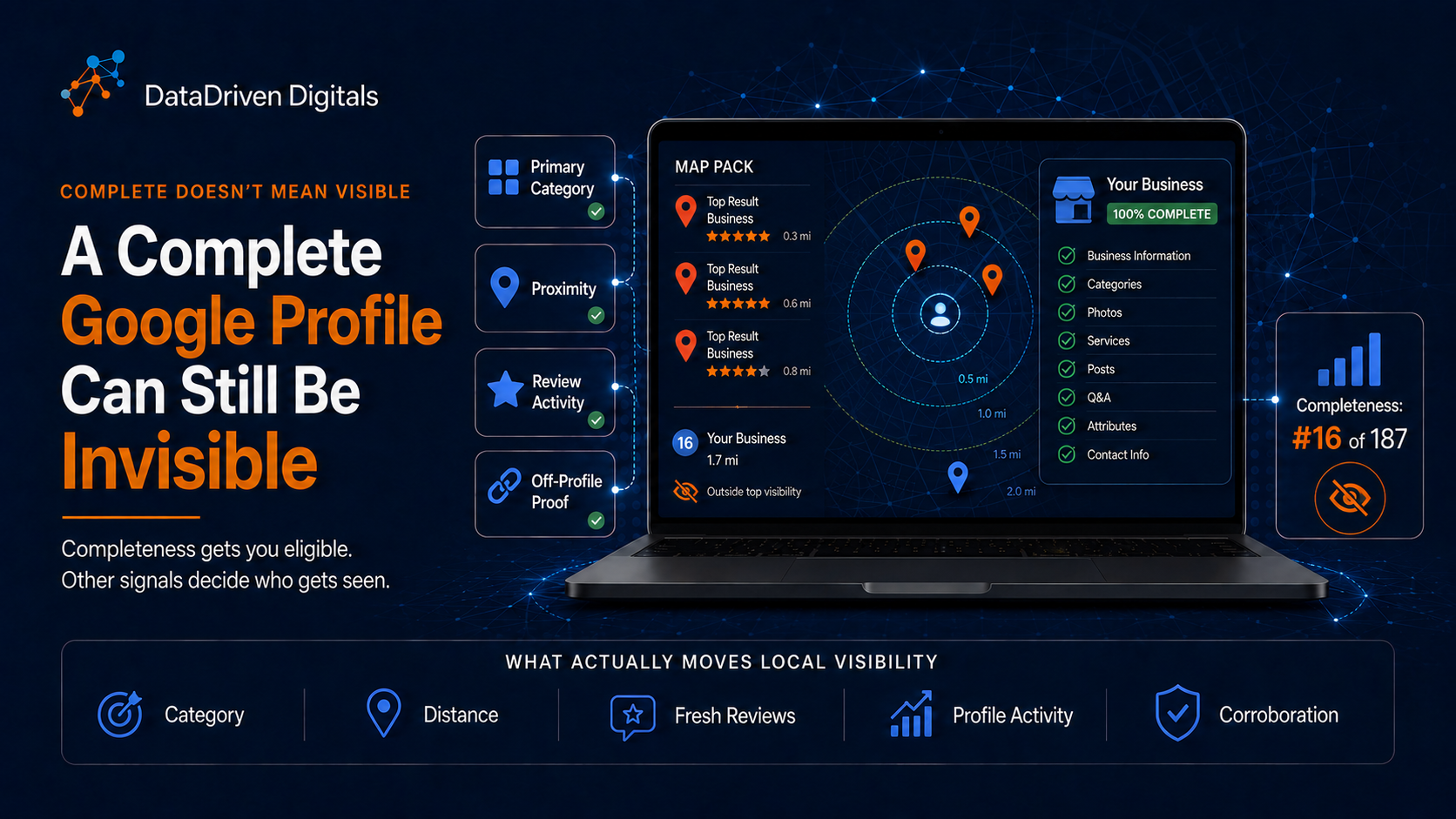
You filled in every field. Category, hours, service list, attributes, description, a logo, a cover photo, thirty real photos of the team and the work. You answer messages fast, you reply to every review, and the checklist says 100%.
You still can't find your own business when you search for it.
That's a genuine pattern, and it has nothing to do with a hidden setting you missed. Completeness works as table stakes: something Google expects before it even considers you, sitting well below the factors that actually pull you up the results. The 2026 data on local ranking factors makes that gap explicit, and knowing where you actually sit fixes more than another pass through your profile settings ever will.
What "complete" actually gets you
Google's own guidance on why a Business Profile might not appear is narrower than most owners assume. A profile has to be verified, or it won't show at all. It has to be free of guideline violations, or it gets disabled or suspended until the issue is resolved. New businesses can take up to a month to appear after verification, and edits can take up to three days to show. None of that is about rankings: it's about eligibility. Completeness gets you into the pool. It doesn't decide where you land in it.
The number that explains the whole problem
Whitespark's 2026 Local Search Ranking Factors report is the largest study of its kind: 47 local SEO practitioners scored 187 individual factors across a two-hour survey, published by Darren Shaw in November 2025. Here's where profile completeness landed against the top of the list:
Completeness sits below the fold. It's beaten by your category choice, by how physically close you are to the person searching, by your review volume and recency, and by whether the doors are open right now. Filling in every field on your profile is closer to a background check than a ranking boost.
That reframes the real question. If a complete profile isn't showing up, the fix is finding which of the higher-weighted factors above is working against you, rather than adding more to the profile itself.
Reason 1: Proximity isn't a field you can fill in
Proximity is the distance between the searcher and your business, and Google calculates it from device location, Wi-Fi and IP signals, and search history. You can't relocate your business to chase a ranking, and no amount of profile completeness offsets standing three miles further from the searcher than your closest competitor.
It also isn't uniform. Gridded local ranking studies show how much this varies by market: one analysis cited by Am I Cited found businesses held consistent rankings across only 27% of a search grid in Pittsburgh, compared to 92% in Queens. In dense markets, who ranks for "your city plus your service" can change block by block. A profile that's invisible from one search point can be sitting in the map pack three streets away.
Two things follow from that. First, before assuming something is broken, check rankings from several points across your service area, and stop testing from only your own office address. Second, when a searcher is genuinely far away, strong prominence signals (reviews, corroboration, activity) can close some of that gap. They rarely close all of it. Distance is a real ceiling.
Reason 2: Prominence is earned after you're complete, not by being complete
BrightLocal's 2026 ranking factor research breaks local pack ranking influence into categories:
|
Category |
Approx. weight |
|---|---|
|
Google Business Profile signals |
32% |
|
Reviews |
20% |
|
On-page content |
15% |
|
Behavioral (calls, clicks, directions) |
9% |
|
Links |
8% |
|
Citations |
6% |
|
Personalization |
6% |
|
Social |
4% |
Reviews grew from 16% to 20% year over year, the single biggest shift in the study. Your Google Business Profile bucket is the largest single category at 32%, but completeness is only one line item inside it, sitting alongside category accuracy, posting frequency, and photo count. A profile that stopped changing eighteen months ago, even a complete one, reads as inactive next to a competitor posting weekly and adding fresh photos.
The practical read: a rival with a thinner "About" section but four new reviews this month and a Tuesday post habit is very likely to sit above a static, complete profile that hasn't moved since setup.
Reason 3: You might be crowded out, not filtered out
Sometimes the problem isn't your profile at all. It's the company it's keeping.
Google's own transparency numbers show the scale of what's competing for the same map pack spots. In its most recent enforcement report, covering 2025 and published on the official Google blog in April 2026, Google says it blocked or removed more than 292 million policy-violating reviews, blocked 79 million inaccurate or unverified edits, removed more than 13 million fake Business Profiles, and placed posting restrictions on over 782,000 accounts, all in a single year.
That volume isn't evenly spread. A multi-year Sterling Sky analysis of 5,306 listings across 16 industries found entire categories where the majority of listings were fake: 87.6% in garage door repair, 80.2% in junk removal, 75.7% among personal injury lawyers. If you compete in a category like that, a clean, complete, fully legitimate profile is sharing the map pack with a wave of listings using fake addresses or lead-gen fronts, at least until Google catches up. Reporting spam competitors through Google's redressal process is slower than most owners would like, but it's still the correct move, alongside continuing to build your own legitimate signals.
The other side of this: Google's spam filters occasionally catch real businesses in the net meant for fake ones. If your listing recently changed address, name, or category, or if it was ever flagged and reinstated, that history can suppress visibility independent of how complete the profile looks today.
Reason 4: AI Overviews aren't reading your profile the same way
This is the newest layer, and it's the one most local search advice hasn't caught up to yet. AI Overviews now appear on close to half of all Google searches, up 58% year over year per BrightEdge research reported by Search Engine Journal, and the same research found only about 17% of AI Overview sources also sit in the organic top 10. Ranking well and getting cited are correlated, not identical.
For local queries specifically, an AI-generated answer isn't built purely from your Google Business Profile. It draws on the wider indexed web: your site, review platforms, forums, anything that corroborates what your profile claims. A profile can be complete, verified, and ranking respectably in the map pack, and still never surface in the AI-written answer sitting above it, because the model didn't find enough outside confirmation to quote you with confidence. We covered the specific signals driving those citation decisions in our breakdown of the trust signals Google and AI systems use in 2026; the short version is that corroboration across independent sources now carries more weight than anything you say about yourself.
|
What your seeing |
Likely cause |
Check this |
|---|---|---|
|
You show up for your exact business name, not for the service category |
Category or relevance issue |
Primary category accuracy, service list completeness |
|
You rank near your address, disappear a few miles out |
Proximity |
Rankings checked from several points across your service area |
|
Complete profile, but reviews are old or sparse |
Prominence |
Review velocity and recency over the last 90 days |
|
Competitors nearby look generic, stock-photo, or freshly created |
Category may be spam-heavy |
Report suspicious listings; keep building your own signals |
|
You rank in the map pack but never appear in the AI-written answer |
AI-surface gap |
Corroboration off-profile: reviews, forums, your own site content |
|
Profile disappeared entirely, no warning |
Suspension or verification issue |
Business Profile status in Google Business Profile Manager |
What actually moves a complete profile into view
- Get the primary category exactly right, and test close alternatives. It's the single highest-weighted factor in the 2026 Whitespark study.
- Keep hours genuinely current, holidays included. Being open when someone searches is worth more than most owners assume.
- Build steady review velocity, not a one-time push. Four to eight substantive reviews a month, with replies to all of them, beats a burst of twenty followed by silence.
- Post weekly. An active profile reads as prominent; a static one, even a complete one, doesn't.
- Use your real, legally registered business name only. Google's own guidelines prohibit adding keywords to your business name to game rankings, and it's grounds for suspension. Earn the "keyword match" signal through your actual name and category, not by editing it.
- Get corroborated off your own site, on review platforms, in local press, in forums. That's what closes the gap for both map pack prominence and AI citations.
- Report spam competitors through Google's redressal process when a category looks flooded with fake listings, and don't wait on it to be the only strategy.
Conclusion
A complete profile keeps you in the running. It doesn't move you up the field. Proximity, category precision, review activity, and how well you're corroborated across the rest of the web are doing that work, and the 2026 data is specific about the order they matter in. Check your rankings from more than one point in your area, look at your review activity over the last quarter rather than all-time, and see whether your business is confirmed anywhere Google doesn't control before adding another field to a profile that was never the bottleneck.
For the full 90-day build-out of every signal in the table above, see our complete local SEO guide for independent service businesses.
FAQs
My profile is 100% complete and a competitor with less information outranks me. How? Completeness ranked 16th out of 187 factors in the 2026 Whitespark study. Category accuracy, proximity, and review activity all outweigh it. Check those first.
Can strong reviews overcome a proximity disadvantage? Partially. Prominence signals can extend your reach beyond your immediate radius, especially for a specialized service, but they rarely fully offset a searcher being genuinely closer to a competitor.
How do I know if I'm suspended versus just outranked? Check your listing status directly in Google Business Profile Manager. A suspended or disabled profile won't appear at all, anywhere, which is different from ranking below competitors.
Does fixing my profile guarantee I'll show up in AI Overviews? No. AI Overviews pull from sources beyond your profile, including review platforms and independent mentions. A complete, well-ranked profile is a starting point, not a guarantee of citation.
Should I keyword-stuff my business name since it's a top-ranked factor? No. Google's guidelines explicitly prohibit it, and it's a common cause of suspension. The correlation in ranking studies reflects businesses whose real names happen to include a service term, not a tactic to copy.
-->