|
Question |
What you're checking |
High-readiness signal |
|---|---|---|
|
Volume |
Does this happen often enough to matter? |
Weekly or higher frequency, repeated across segments/channels |
|
Structure |
Does it follow a repeatable pattern? |
Clear inputs → decision rules → outputs, minimal one-off judgment |
|
Data quality |
Is there clean, sufficient historical data to learn from? |
Structured fields, consistent tagging, enough volume to find patterns |
|
Judgment required |
Does it need brand taste, empathy, or strategic trade-offs? |
Low: the "right answer" is measurable, not subjective |
How To Build Marketing Processes AI Can Actually Improve
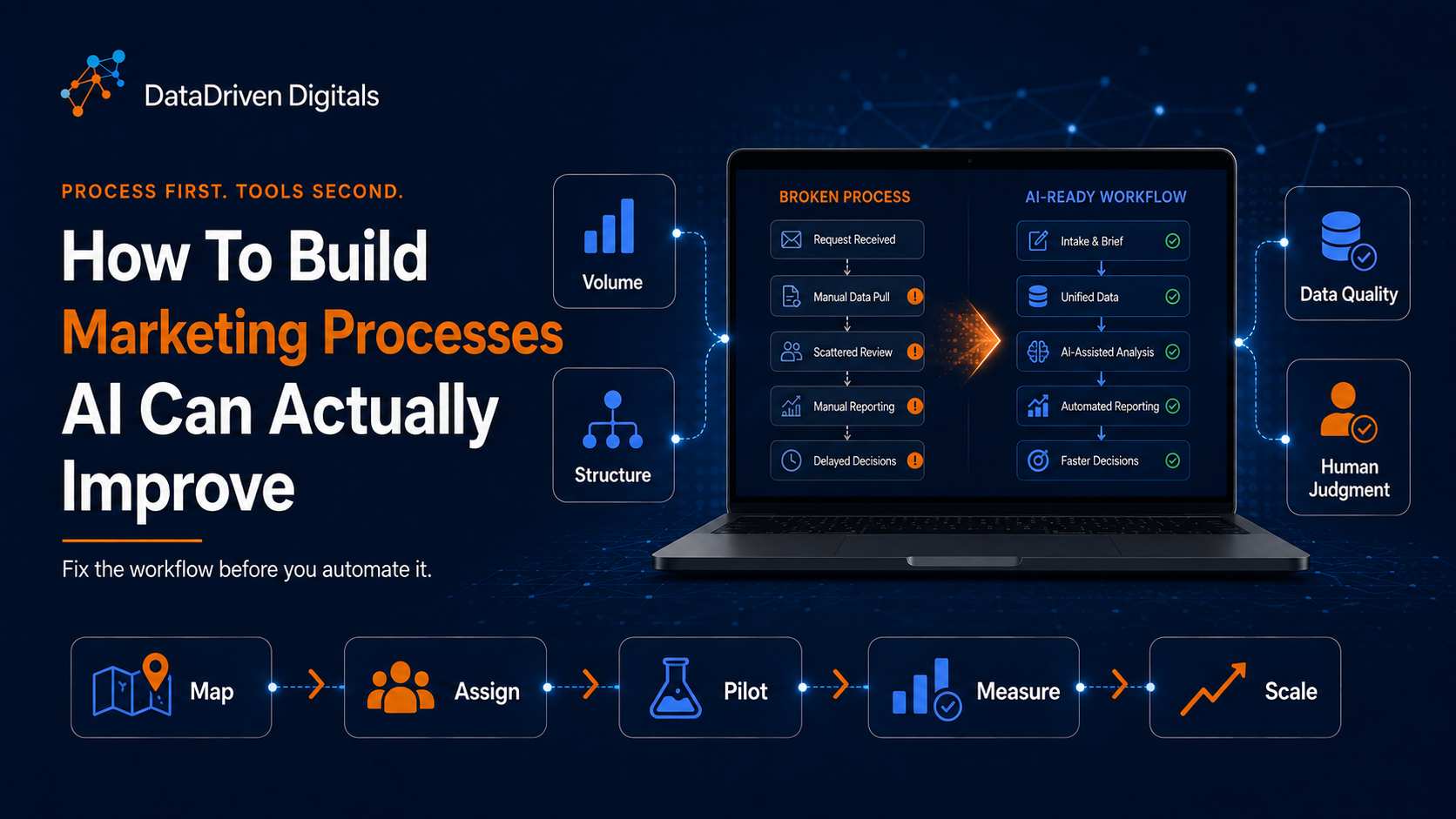
Nearly 90% of CMOs say they're experimenting with AI somewhere in their marketing process. McKinsey research finds fewer than 10% have captured value from it end to end. That gap is a process problem, not a tooling one.
Most "AI marketing" advice starts with the tool: which chatbot writes better subject lines, which platform auto-optimizes ad spend. That's backwards. AI doesn't fix a broken process, it makes the broken process faster. Bolt a large language model onto a chaotic content calendar or an undefined lead-scoring system, and you get chaos at scale.
The marketers actually seeing returns are doing something different: they're auditing their processes first, then deciding where AI belongs. This guide walks through exactly how to do that: which processes are worth automating, which ones to leave alone, and the build sequence that keeps a pilot from turning into another abandoned experiment.
Why Most AI Marketing Efforts Stall Before They Pay Off
Before building anything, it helps to understand why so many AI initiatives don't survive contact with reality.
Agentic AI projects are getting canceled at scale. Gartner predicts that more than 40% of agentic AI projects will be scrapped by the end of 2027, citing escalating costs, unclear business value, and inadequate risk controls. Gartner analyst Anushree Verma put it plainly: most of these projects are "early stage experiments or proof of concepts that are mostly driven by hype," and the fix is "rethinking workflows with agentic AI from the ground up" rather than dropping AI into a legacy system.
Data readiness is the silent killer. A Gartner survey of 1,203 data management leaders found that 63% of organizations either lack, or aren't sure they have, the right data practices to support AI. Gartner predicts that through 2026, 60% of AI projects will be abandoned because the underlying data simply isn't ready. If your CRM fields are inconsistent or your campaign data lives in five disconnected spreadsheets, no model is going to fix that for you.
Tool-first thinking beats process-first thinking, but process-first wins. McKinsey's research on agentic marketing workflows found that organizations reporting real financial returns had reimagined the workflow before selecting a tool, not the other way around. The firms bolting AI onto existing marketing tech stacks (multiple CMS, DAM, CRM, and analytics platforms that were never built to talk to each other) end up with more activity and little enterprise-wide benefit: what McKinsey calls the "gen AI paradox," the technology is everywhere except the bottom line.
The takeaway: before you touch a tool, you need a way to score which of your existing processes are even good candidates for AI.
The AI-Readiness Test: 4 Questions to Ask Before Automating Any Process
Not every marketing task benefits equally from AI. Run each process through these four questions before you invest in automating it.
A process that scores well on all four (high volume, structured, clean data, low subjective judgment) is a strong AI candidate. A process that's low-volume, judgment-heavy, and thin on data should stay human-led, at least for now.
Which Marketing Processes AI Can Actually Improve
Here's how common marketing processes score against that test, based on where AI is already delivering measurable results.
|
Marketing Process |
AI Improvement Potential |
Why |
|---|---|---|
|
Lead scoring & routing |
High |
Structured CRM data, clear historical outcomes, high volume |
|
Ad bid & budget optimization |
High |
Real-time performance data, repeatable decision logic, immediate feedback loop |
|
Email send-time & segmentation |
High |
Large behavioral datasets, measurable open/click outcomes |
|
Reporting & dashboard creation |
High |
Repetitive data aggregation, low judgment, high time cost to humans |
|
SEO/keyword and competitive research |
Medium-High |
Structured data available, but still needs strategic filtering |
|
Social post scheduling & first-draft copy |
Medium |
Repeatable format, but brand voice still needs human review |
|
Creative concept testing (pre-testing, variant generation) |
Medium |
Speeds up iteration; humans still choose what resonates |
|
Customer segmentation for personalization |
Medium-High |
Strong with clean CRM/behavioral data; weak with fragmented data |
|
Brand positioning & messaging strategy |
Low |
Requires taste, market feel, and stakeholder judgment |
|
Crisis communications & sensitive outreach |
Low |
High stakes, low tolerance for error, relationship-dependent |
This lines up with what Gartner is now forecasting for paid media: by 2028, more than 70% of global ad spend, and 80% of U.S. ad spend, will move through self-serve platforms where AI materially influences buying, pricing, and outcomes. Ad ops is one of the most structured, data-rich processes in marketing, which is exactly why it's furthest along. Gartner VP Analyst Eric Schmitt adds a caution worth keeping in mind, though: "improved platform economics does not necessarily translate into lower costs for the advertiser." CMOs still need independent measurement of results, separate from platform-reported wins.
The 5-Step Framework for Building an AI-Improved Process
Once you've identified a high-readiness process, don't just plug in a tool. Build the workflow deliberately. This sequence draws on McKinsey's five-step model for agentic marketing workflows, adapted for teams that don't have an enterprise AI budget.
- Map the process as it actually runs today. Break it into every micro-step, not the idealized version but the real one, including the manual workarounds. You can't redesign what you haven't documented.
- Decide what AI handles and what a human handles. Assign each micro-step to "AI-executed," "AI-assisted, human-approved," or "human-only." This is the step most teams skip, and it's the one that prevents AI output from reaching customers unreviewed.
- Pick one narrow pilot, not a department-wide rollout. Choose the highest-volume, highest-structure process from your readiness table (email segmentation or reporting are usually good starting points) and run it in isolation before expanding.
- Set a baseline and measure against it. Track the specific metric the process is meant to move (time-to-report, cost-per-acquisition, open rate) before and after. Without a baseline, you can't tell a real gain from a coincidence.
- Scale in waves, not all at once. Expand to adjacent processes only after the pilot proves out. McKinsey found that companies rolling out agentic workflows in phases, ideation first, then safeguards, then global scale, saw compounding gains, in one case speeding up a content pipeline fourfold versus the manual process.
What to Keep Human, On Purpose
Speed and automation aren't the goal in themselves. The goal is freeing people for the work AI genuinely can't do. McKinsey's research points to the roles marketers should double down on: developing strategy based on qualitative judgment and "taste," building relationships with stakeholders and customers, and handling in-person activations, the kind of work that doesn't reduce to a decision rule.
HubSpot's 2026 State of Marketing report backs this up from the audience side: 61% of marketers say AI represents marketing's biggest disruption in 20 years, and 80% now use AI for content creation. Even so, the report's own framing is that "AI is the baseline, not the differentiator." When everyone has the same tools, the brands with a clear, human point of view are the ones that stand out.
Practically, that means protecting time for:
- Brand positioning and go-to-market strategy
- Final review of anything customer-facing before it ships
- Relationship-based outreach (sales handoffs, partnerships, PR)
- Creative judgment calls on what actually resonates, beyond what tests well
Ikea is a useful real-world proof point here. When Ingka Group rolled out its AI customer service bot, Billie, in 2021, it didn't use the freed-up capacity to cut headcount. Over two years, it retrained roughly 8,500 call center workers to handle more complex queries or work as sales-oriented interior design advisors, roles that lean on judgment, product knowledge, and relationship-building rather than script-following. The bet paid off: those remote-sales centers became Ikea's fastest-growing sales channel, generating €1.25 billion ($1.37 billion) in sales last fiscal year, and the company's customer happiness score rose from 60% to 89%. Billie now handles 74% of customer queries on its own, up from 47% at launch. The humans handle the sale.
If you automate every task that builds a marketer's instincts, you end up with a team that can supervise AI output but can no longer produce or recognize great work themselves. That's a real risk worth designing around, not an afterthought.
Common Mistakes That Turn a Promising Pilot Into a Failed One
- Skipping the data audit. If your data isn't AI-ready (inconsistent CRM fields, no historical tagging, siloed platforms) fix that first. It's the reason Gartner expects 60% of AI-ready-data-deficient projects to be scrapped through 2026.
- Automating a process nobody agreed on. If your team doesn't already agree on how lead scoring should work, AI will just automate the disagreement faster.
- No human checkpoint before publish. Every AI-assisted process needs a defined point where a person reviews output before it reaches a customer.
- Measuring activity instead of outcomes. More content produced isn't a win if conversion rates don't move. Tie every pilot to a business metric, not a volume metric.
- Trying to transform everything at once. The teams that stall are the ones that try to overhaul the entire martech stack in one push instead of proving value process by process.
Build the Process First, Then Add AI
The pattern across every credible source here, Gartner, McKinsey, and HubSpot, is the same: AI rewards teams that redesign the workflow before they pick the tool, and it punishes teams that don't. Run your processes through the readiness test, start with the ones that score highest, keep a human in the loop where judgment matters, and measure everything against a baseline.
That's the difference between the 90% still experimenting and the 10% actually capturing value.
Want help auditing your search and paid media processes for AI readiness? Data Driven Digitals helps businesses figure out where AI actually moves the needle in SEO, AEO, and PPC, and where it doesn't: process first, tools second.
-->